

Trip Overview
Departures
Click for Dates + Prices
Duration
10 Days
Activities

Cultural

Hiking
Physical Rating
Moderate
Be the First to Know
Interested in this trip? Get on the list for exclusive information and updates.
A Transformative Hiking & Cultural Journey in Japan
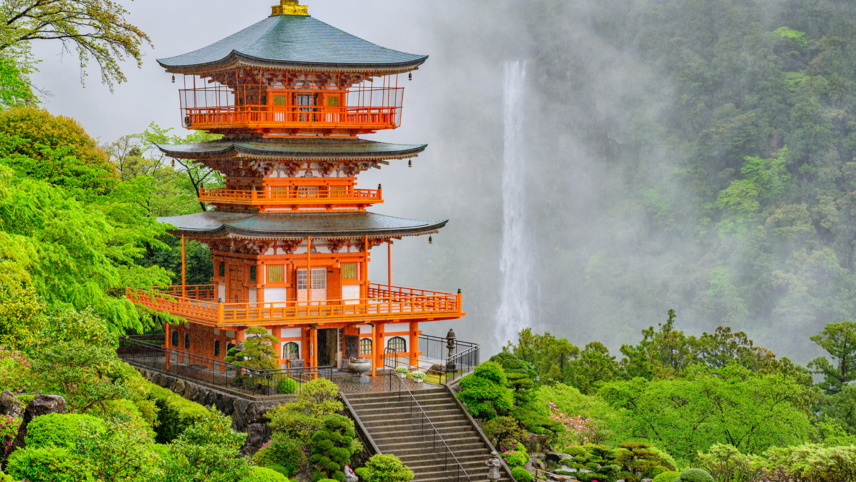
On our Japan Kumano Kodo Hiking Adventure, you’ll explore a tapestry of culture and tradition, from Osaka’s vibrant streets to Kyoto’s timeless beauty. In Japan, meditation and reflection aren’t just practices—they’re woven into the very fabric of life. And nowhere is this more evident than on the ancient Kumano Kodo pilgrimage. For four unforgettable days, you’ll walk this sacred route, from Takahara to the awe-inspiring Kumano-Nachi Grand Shrine.
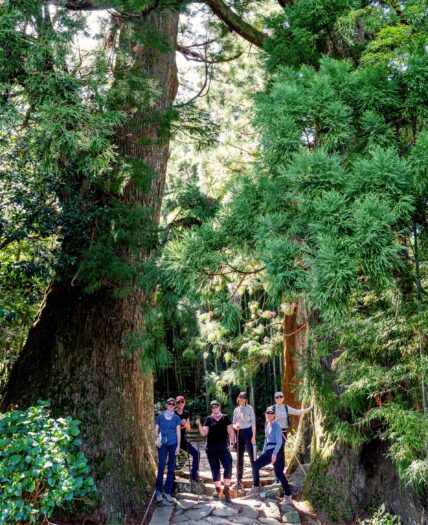
As you move through camphor and bamboo forests and stand beneath the towering thousand-year-old conifers of the Kii Mountain region, you’ll feel the weight of history. You’ll follow in the footsteps of monks, philosophers, and the brave female pilgrims once banned from entering Koyasan’s holy sites. This is more than a journey—it’s a soul-deep connection to a land steeped in wonder.

Kumano Kodo Hiking Adventure
Feel the Spirit of Japan’s Living Traditions
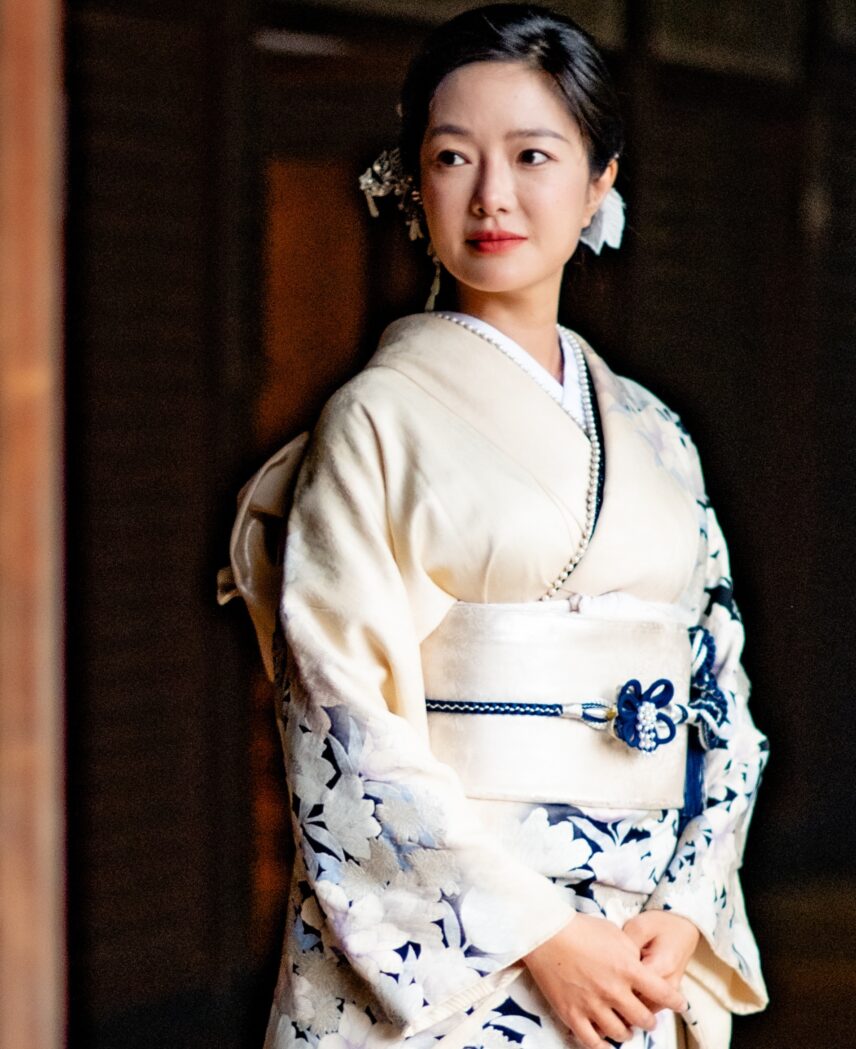
On this journey through Japan, we dive deep into the ancient practice of Shugendō, unravel the stories behind stunning shrines and temples, and explore the fascinating evolution of the Women’s Pilgrimage Course.
By night, we rest in traditional ryokans, sinking into the comfort of tatami mats, and at day’s end? It’s all about soaking in the rejuvenating onsens. Your taste buds (and soul) are in for a treat—get ready to discover local flavours and experiences.


More Trips Recommended for You


-
Sacred Japan
Japan
-
Departures:
Oct, Apr
-
Trip Duration:
12 Days


-
Bali Explorer
Bali, Indonesia
-
Departures:
Sep, Oct, Apr, May, Jun
-
Trip Duration:
11 Days


-
Northern Thailand Active Adventure
Thailand
-
Departures:
Oct, Nov, Dec, Jan, Feb
-
Trip Duration:
11 Days


-
Bhutan Hiking Adventure
Bhutan
-
Departures:
Oct, Nov, Apr
-
Trip Duration:
13 Days

Itinerary
-
Day 1
Osaka
Your Japan Kumano Kodo Hiking Adventure Begins
Your Japan Kumano Kodo Hiking Adventure begins! Arrive at Osaka’s Kansai International Airport (KIX), where a group transfer or private taxi will bring you to our hotel. Take a moment to settle in, exhale, and arrive fully in Japan.
Before dinner, meet your Wild Women guide and fellow travellers for a warm welcome and trip briefing. As stories begin to unfold over a shared meal, you’ll feel the energy of what’s ahead—this is where our journey together begins.
Included Meals
Dinner
Accommodations
Hotel Royal Classic Osaka or similar
Travel
Airport Transfer approximately 1 hour
-
Day 2
The Sacred Kumano Kodo
From Takijiri-oji to Takahara: Walking the Kumano Kodo
After breakfast, we board an early train to Kii-Tanabe, enjoying lunch along the way as the landscape begins to change. From there, a short bus ride brings us to Takijiri-oji—the traditional gateway to the Kumano Kodo.
Before setting out, we visit the Kumano Kodo Kan Pilgrimage Center to deepen our understanding of this UNESCO World Heritage route—an ancient network of sacred trails once walked by emperors and pilgrims seeking spiritual renewal. Rooted in centuries of nature worship, this region of the Kii Peninsula carries a quiet, powerful energy you’ll begin to feel the moment you arrive.
From Takijiri-oji, our first walk begins. The trail climbs steadily through forested paths toward the ridge-top village of Takahara, offering sweeping views of the Hatenashi mountain range. It’s a challenging but rewarding introduction to the pilgrimage—one that invites you to slow down, breathe deeply, and connect with the journey ahead.
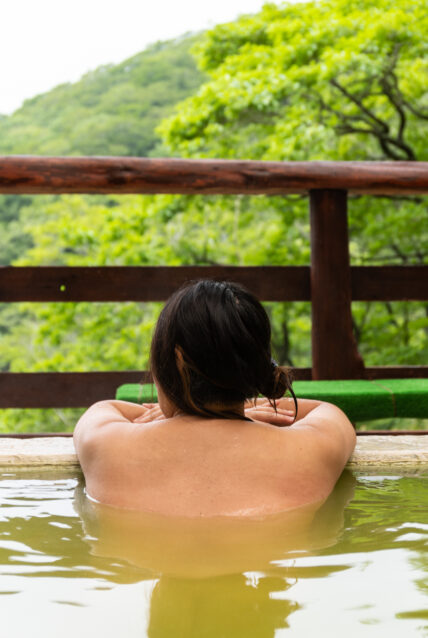
Upon arrival, unwind in a traditional onsen (hot spring), letting the day melt away before gathering for a nourishing multi-course dinner.
Included Meals
Breakfast, lunch and dinner
Accommodations
Organic Hotel Kirinosato or similar
Travel
Train (2.5 hours), bus (45 minutes)
The Walk
Takijiri-Oji to Takahara: 4 km (2.5 miles); 3 km (2 miles) unpaved
Total elevation gain: ~ 420 m (1370 ft)
Total elevation loss: ~ 190 m (610ft)Time required: ~ 2 hours
-
Day 3
Kumano Kodo
Walk Deeper into the Kumano Kodo: Mountain Trails & Sacred Forests
On foot, we journey further into the mountains along the ancient pilgrimage trail, each step drawing us deeper into the rhythm of the land. Along the way, we pass an ichirizuka milestone—an earthen marker that once guided travellers along historic routes—before pausing to enjoy a lunch of local flavours.
Continuing through quiet forest paths, we reach the Hashiori-Toge Pass after a gentle climb. From here, we descend along a beautifully preserved cobbled trail and stone steps into the village of Chikatsuyu. Our final stretch leads us upward once more to Tsugizakura-oji, a sacred site known for its towering cedar trees and crystal-clear springs.
From here, we transfer by vehicle to our onsen, tucked deep within the sacred mountains of Kumano. At our traditional ryokan, settle into stillness and rest—tonight, we sleep surrounded by centuries of story and forest.
Included Meals
Breakfast, lunch and dinner
Accommodations
Yunomineso or similar
The Walk
From Takahara to Tsugizakura-oji: ~ 13km (8 miles)
Total elevation gain: ~ 990 m (3230 ft)
Total elevation loss: ~ 780 m (2560 ft)
Unpaved trail up to Chikatsuyu and then paved road to Tsugizakura-oji.
Time required: About 4 – 5 hours (slower walkers may require up to 6 hours)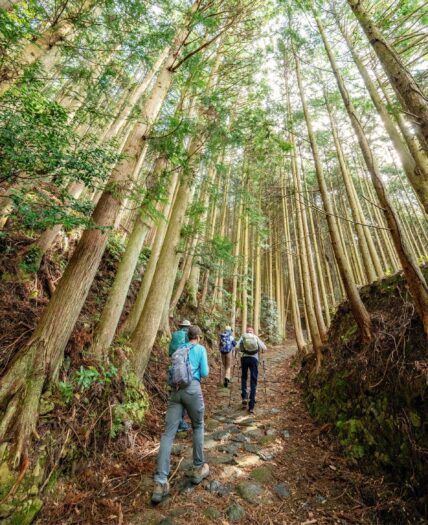
-
Day 4
Pilgrimage to Hongu Taisha
Sacred Encounters on the Kumano Kodo
This morning, we take a short local bus ride to Hosshinmon-oji—one of the most revered entry points along the Kumano Kodo—where today’s walk begins. The trail follows a gentle ridge through quiet villages and lush forest, offering a peaceful, reflective pace as we make our way toward Hongu Taisha, one of the region’s most important shrines. We pause here for lunch, taking in the significance of this sacred site.
In the afternoon, depending on timing, we return toward Yunomine via the Dainichi-goe route—either by bus or on foot. This short but steep trail crosses Mt. Dainichi and leads us through forested terrain to Oyunohara, the original shrine grounds marked by a towering torii gate. Along the upper ridge, we pass a small shrine once connected to the Shugendo tradition.
A special highlight today: we are joined by a female yamabushi—an ascetic practitioner of Shugendo—alongside her daughter, offering a rare and meaningful glimpse into this ancient spiritual practice. Back at our hotel, unwind in the restorative waters of Yunomine Onsen, letting the experience of the day settle in.
Included Meals
Breakfast, lunch and dinner
Accommodations
Yunomineso or similar
The Walk
Hosshinmon-oji to Hongu Taisha: ~7 km (4.5 miles)
Total elevation gain: ~175m (570 ft)
Total elevation loss: ~ 440m (1440 ft)
Trail: mix of paved road and unpaved trail
Time required: ~2.5 hours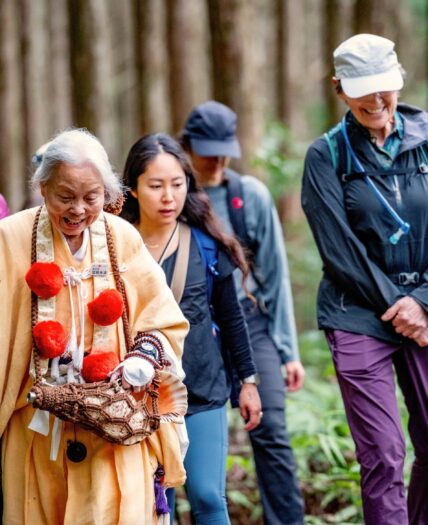
-
Day 5
Grand Shrines Hayatama Taisha & Nachi Taisha
Ancient Shrines & The Spiritual Heart of Kumano
After breakfast, we travel by private vehicle to Kumano Hayatama Taisha Grand Shrine, where you’ll have time to wander the sacred grounds and take in the quiet power of this ancient site.
From here, we continue to Kumano Nachi Taisha and begin our walk along the Daimon-zaka Shrine Approach—a beautifully preserved cobblestone staircase of 267 steps that winds through towering cedar forest. At the base, the intertwined Meotosugi (“husband and wife” cedar trees) offer a striking symbol of connection, while above, the path leads us toward one of Japan’s most iconic spiritual landscapes: Seiganto-ji Temple and the breathtaking Nachi Waterfall.
In the afternoon, we journey onward to our seaside inn on Katsuura Bay. Here, you can unwind in a variety of indoor and outdoor onsens overlooking the water before sitting down to a multi-course dinner featuring fresh, local seafood. After settling in, we gather once more for a traditional evening together—ending the day with rest, reflection, and the soothing ritual of the hot springs.
Included Meals
Breakfast, lunch and dinner
Accommodations
Kyukamura Nanki-Katsuura or similar
Travel
Private shuttle: 1 hour to shrine and 30 min to hotel
The Walk
Nachikatsura to Kumano-Nachi Taisha: ~1.5 km (1 mile)
Time required: 40 minutes (Daimonzaka is a short slope with a 600-metre staircase)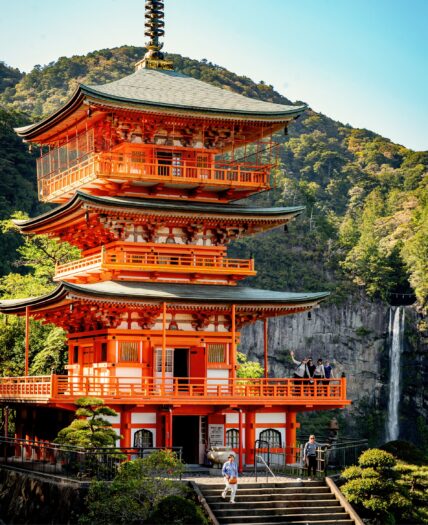
-
Day 6
Koyasan
Mount Koyasan: Sacred Stillness in the Mountains Of Japan
This morning, we journey by private bus to Mount Koyasan, a խաղաղ mountain sanctuary nestled high in the cedar-covered peaks of the Kii Peninsula. Founded in the 9th century by the monk Kukai (Kobo Daishi), this sacred site has long been a centre of Shingon Buddhism and spiritual practice.
Today, Koyasan is home to over 100 monasteries—many of which open their doors to pilgrims. Tonight, we stay in a traditional shukubo (temple lodging), where we’ll experience monastic hospitality and enjoy Shojin-Ryori, a beautifully prepared Buddhist vegetarian meal rooted in mindfulness and simplicity.
We’ll visit Kongobu-ji temple and Danjo Garan, one of the two most sacred sites on Mount Koya and the heart of Shingon Buddhist worship. The temple complex is home to Konpon Daito, an impressive vermilion pagoda traditionally regarded as the center of Koyasan.
Included Meals
Breakfast, lunch and dinner
Accommodations
Shukubo or Temple stay, Koyasan
Travel
Private Shuttle: 2.5 hours
The Walk
Independent exploration of Koyasan
-
Day 7
Women’s Pilgrimage Course
Walking the Historic Women’s Pilgrimage Trail of Koyasan
Your Japan Kumano Kodo Hiking Adventure continues today with a truly special experience—joining the monks for Gongyo, their morning prayers, offering a quiet and grounding start before breakfast.
Later, we set out on a meaningful hike along a section of the historic Women’s Pilgrimage Route. Until the later years of the Meiji era, women were barred from the main grounds of Koyasan’s monastic complex. So they built their own path. Sanctuaries rose in the hills around the mountain, later known as Nyonin Koya, Women’s Koya. Female pilgrims circled the sacred complex along the ridgelines, catching glimpses of the training grounds from a distance. That ridge trail became Nyonin Michi, the Women’s Pilgrimage Route.
After our hike, we transfer by private coach to Kyoto. The evening is yours to explore, unwind, or simply soak in the atmosphere of this iconic cultural city.
Included Meals
Breakfast, lunch and dinner
Accommodations
Noku Kyoto or Cross Hotel Kyoto hotel (or similar)
Travel
Private transfer (3 hours) to Kyoto
The Walk
Distance: ~ 9km km 5.1 miles from Oku-no-in bus stop to Okunoin Torodo, around the loop
Elevation gain: ~ 411 m / 1,348 feet of ascent and 374 m / 1,227 feet of descent
Paved roads and forest trail
Time required: 3-4 hours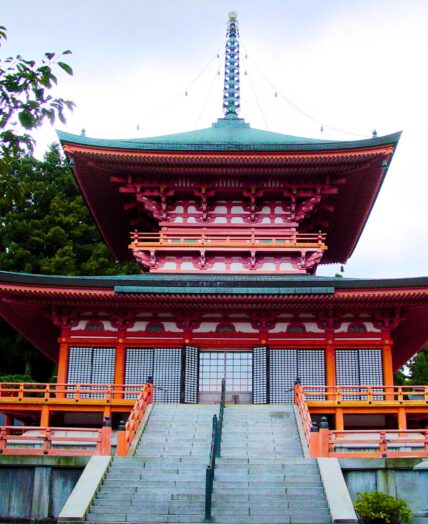
-
Day 8
Hiking Kurama to Kibune
Sacred Trails: Hiking Mount Kurama to Kifune Shrine
This morning, we travel by train from Kyoto to the mountain village of Kurama, where today’s hike begins. Nestled in the forested hills north of the city, Mount Kurama has long been a place of spiritual training—where samurai once studied alongside mountain Buddhist practitioners. From Kurama-dera Temple, we set out on a scenic trail that winds through towering cedar forests and quiet mountain paths.
As we make our way across the ridge, the landscape opens into moments of stillness and beauty—shrines tucked into the trees, soft light filtering through the forest, and the steady rhythm of footsteps grounding us in the experience. Our hike leads us to Kifune Shrine, dedicated to the water deity Takaokami no Kami and known as a place to seek blessings for love, connection, and renewal. Set near the source of the Kamogawa River, it’s a place that feels both sacred and deeply restorative.
We take time here to explore, pause, and soak in the atmosphere before making our way back to Kyoto. The evening is yours to enjoy—whether that’s wandering lantern-lit streets, sharing a meal, or saying yes to a little karaoke!
Included Meals
Breakfast, lunch
Accommodations
Noku Kyoto or Cross Hotel Kyoto hotel (or similar)
Travel
Kyoto public transportation to and from the hike
The Walk
6.5km (4 miles)
Elevation gain: ~300m (~1,000 ft)
Elevation loss: 420m (~1,375 ft)
-
Day 9
Kyoto
Kyoto’s Cultural Pathways: From Zen Gardens to Gion Traditions
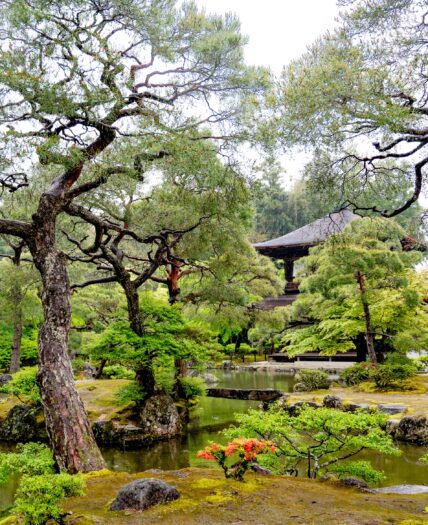
We begin the day with a short shared taxi ride to the Silver Pavilion (Ginkaku-ji), a serene Zen temple tucked into Kyoto’s eastern mountains. From here, we set out along the Philosopher’s Path—a peaceful canal-side trail once walked by renowned thinker Nishida Kitaro. Lined with trees, small shrines, and hidden shops, this gentle walk invites curiosity, reflection, and the joy of wandering.
As we follow the path, there are opportunities to explore side streets filled with local charm before arriving at Nanzen-ji, a stunning Zen temple complex known for its tranquil gardens and historic aqueduct. One of its quiet delights is a tucked-away tea room overlooking a small waterfall—an ideal place to pause. Here, you may wish to try yudofu, a simple yet nourishing tofu dish infused with kombu (seaweed), beloved in the region.
This evening, we gather for a memorable farewell in Kyoto’s iconic Gion district. Over a beautifully prepared seasonal dinner, we are treated to a traditional performance by a Geiko (Geisha) or Maiko (apprentice). These highly trained artists embody centuries of refined Japanese culture, offering an unforgettable glimpse into the elegance and artistry of Kyoto.
Included Meals
Breakfast, lunch and dinner
Accommodations
Noku Kyoto or Cross Hotel Kyoto hotel (or similar)
TRAVEL
Taxi (30 minutes)
The Walk
Short and sweet but profound! It’s 1.2 miles (2 km).
-
Day 10
Departure
Closing the Kumano Kodo Journey
Your Japan Kumano Kodo Hiking Adventure has come to an end! After an early breakfast, transfers to Kansai International Airport (KIX) are coordinated via the Haruka train. A taxi from the hotel to Kyoto Station is included, and your guide will be on hand to assist with directions and ensure a smooth departure.
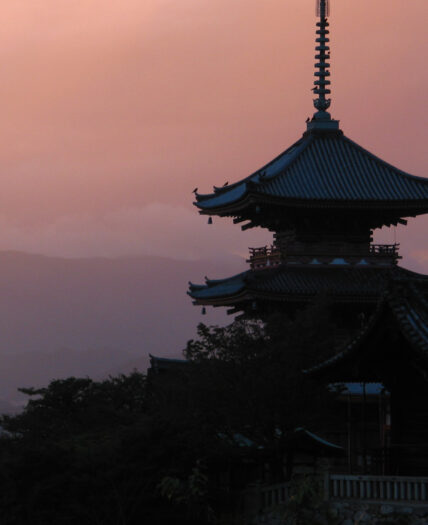
As this remarkable journey comes to a close, we part ways with full hearts—exchanging contact details, photos, and memories from the road. The pilgrimage may be ending, but the connections and reflections carry on. Where to next?
Included Meals
Breakfast


What’s Included
- One shared arrival transfer per person from Kansai Airport (KIX) or private taxi from Itami Airport (ITM) to the Osaka hotel arriving up to 2 days pre-trip.
- Departure transfer from the Kyoto hotel on the final night to Kansai Airport (KIX) by Haruka train including taxi transfer from the hotel to Kyoto Station.
- 9 nights accommodation (based on twin share) in Western style hotels, ryokan, and minshuku. Japanese-style accommodations will generally be in tatami-mat rooms.
- Meals as outlined in the trip itinerary
- Japanese Wild Women Expeditions hiking guide throughout the trip
- All transportation between tour locations is included. This will normally be by trains (bullet trains and local trains in standard class), bus, motorcoach and sometimes taxi or private coach.
- Activities as outlined in the trip itinerary,
- Entrance fees to museums, temples, and sights indicated in your itinerary.
- All applicable taxes are included in the trip price.
What’s Excluded
International flights to and from Japan
Any activity expenses not outlined in the itinerary
Items of personal expenditure
Travel insurance including medical/evacuation (required) and cancellation/interruption (highly recommended)
Luggage transfer of more than 1 bag per person
Please note:
Single rooms may be available upon request (pending availability). To request this upgrade, please contact support@wildwomenexpeditions.com. Please note, due to the size of some of the smaller boutique accommodations, we may not be able to secure solo rooms for all nights on this trip. When you are requesting your upgrade, we will confirm the number of nights at that time
Itineraries may be subject to change without notice due to weather and other environmental conditions. Please review our Booking Terms.

Trip Details
The Finer Details
Once you’ve booked your Wild Women Expedition, you’ll receive a link to comprehensive trip details to help you prepare. If you need additional information that’s not on the website, reach out to the Wild Women Expeditions office anytime!
Arrivals and Departures
- This Japan Kumano Kodo Hiking Adventure starts in Osaka and ends in Kyoto, Japan
- Plan arrivals and departures to either Kansai International Airport (KIX) or Itami International Airport (ITM), both in Osaka.
- There is a shared arrival transfer from Kansai Airport (KIX) or private taxi from Itami Airport (ITM) to the Osaka hotel arriving up to 2 days pre-trip.
- There is a departure transfer from the Kyoto hotel on the final night to Kansai Airport (KIX) by Haruka train including taxi transfer from the hotel to Kyoto Station.
- Plan to arrive in Osaka by late afternoon on Day 1 to ensure you can join the meet and greet and trip orientation in the evening.
- Plan departure flights from Osaka on the final day for early afternoon or later.
Accommodation Notes
Hotel (Kyoto, Osaka)
Modern western-style hotels are used in the cities. The rooms are generally smaller than equivalent hotels in the West. All have en-suite facilities, air-conditioning, TV and fridges in rooms. We typically use twin rooms in Japan as these are more prevalent locally for cultural reasons.
Ryokan or Minshuku (Takahara, Yunomine Onsen, Katsuura)
Ryokan are traditional Japanese-style inns. They may be in modern concrete or older wooden buildings but the rooms are always in the Japanese style with tatami (straw) matting and futons laid out in the evening by the ryokan staff. Evening meals are served together usually in the dining room, and are exquisitely prepared multi-course meals. Many ryokan have both en suite bathrooms (with the exception of some older buildings) and communal hot spring style baths (segregated by gender). Minshuku are more commonly smaller family-run properties with warm hospitality. Your minshuku in Takahara is a lodge type property with a mix of Japanese and Western style rooms. Usually guests lay out their own futons and toilet and bathing facilities are communal, segregated by gender. Ryokan and minshuku are the classic Japanese experience.
Shukubo (Koyasan)
These are lodgings in Buddhist temples originally meant for pilgrims, but now open to anyone. The rooms are similar to Ryokan or Minshuku, though with fewer facilities. The food is excellent vegetarian Buddhist ‘Shojin-Ryori’ cuisine. It is a wonderful experience to stay in a Shukubo and there is often the opportunity to join the early morning religious service.
Meals
Most meals will be Japanese cuisine and will draw upon the rich variations of Japanese cuisine. Fish and seafood are a main staple. Meals at the inns are typically set meals showcasing regional specialities.
- Vegetarian options are available, but limited.
- Strict vegetarian diets, vegan diets, or gluten free diets will be difficult to accommodate due to the pervasiveness of the fish-based stock dashi and the use of soy sauce and miso in Japanese cuisine.
- Soy allergies may also be difficult to accommodate.
- If you have severe allergies and cross contamination is an issue, please contact the Wild Women Expeditions office to ensure you can be accommodated.
Tips are not required when dining in Japan. Dietary requests notified whilst on trip can’t be accommodated.
Luggage
During the tour, we send larger items of luggage ahead by courier to make the long-distance transfers by bus and train more relaxed. This means you do not have to handle your larger items of luggage through railway stations and on trains. However, those larger items of luggage do not rejoin us on the same day; and you will not have access to them on certain nights. So please bring a backpack to carry your overnight items. All the Japanese inns on the intervening nights provide soap, shampoo, towels, slippers and cotton robes called yukata, which are worn
inside after you check-in. It is normal in Japan to wear yukata to eat dinner, to relax in your room and when walking about, even outdoors. This means you do not need extra clothing for the evening- you really can travel light!
During the daytime, it may be possible to deposit this backpack in a luggage locker while walking or sightseeing, but please try to pack as lightly as possible. The luggage forwarding takes place as follows:
- Long distance luggage forwarding for 1 larger bag per person on 1 occasion from Osaka Day 2 to Yunomine Day 4.
- Same day hand luggage transfer from Takijiri to Takahara on Day 2, and from Takahara to Yunomine Onsen on Day 3.
As a general guide, we recommend you bring a small to medium size suitcase on wheels, as well as a medium size backpack. Please note that forwarding of one larger item of baggage per person is included in your tour price; if you choose to travel with two larger items of baggage, then your guide will happily arrange forwarding of both items and simply ask you to pay locally for the second item. Please review your packing list to make sure you have everything you need for the trip.
Your suitcase should weigh no more than 55 lbs. at time of departure. The total dimensions of the bag when you add the bag’s external length, width, and height should be no more than 62 inches. (For example, a piece of soft-sided luggage that measured 25 x 18 x 14 would have total dimensions of 25+18+14 or 57 inches and be within these size limits).
Clothing and Equipment
- Yukata (simple cotton kimono) are provided at each ryokan or minshuku, and you can wear this during your stay in the Japanese style accommodation both indoors and outdoors.
- Yukata and slippers provided by regular hotels are normally only used in the private rooms. This will allow you to pack lightly for the walking sections. Soap and shampoo are always available at any accommodations.
- Hairdryers are provided in the regular hotels and in the public bathrooms in Ryokan. They are usually available in some minshuku, too. Bathing suits cannot be used in the public bathrooms.
- For autumn tours: long sleeves are recommended, but you should not need heavy sweaters. You should have a light windbreaker or a rain jacket, light fleece as well as bringing a selection of light layers to wear will be most helpful.
- If bringing any appliance please note that most North American appliances can be used in Japan. Please ensure your appliance has a plug with 2 flat prongs. Outlets in Japan do not accept 3 prong grounded plug types. Some of the minshuku may only have a limited number of outlets in the room so if you are charging more than one item of equipment, you may wish to bring a small multi socket charger.
- There are no porters for this trip, so you will carry your own baggage on/off the trains from and to the airport.
Onsens
Many accommodations in Japan feature onsens. These are public bathing areas, sometimes filled with heated mineral water, and sometimes fed by local hot springs. You will be provided with a small and large towel. You do not wear a swim suit in the onsen and they are gender segregated (women’s and men’s). When you enter the change rooms, there will be lockers for your clothing. Find a shower stall and rinse down well, using the soap and small towel provided. Then find your way into the onsen for a quiet soak. It’s important to be mindful of other women using the onsen and to keep voices low. These are quiet spaces.
A common question asked is whether you can enter an onsen if you have a tattoo. It is an unwritten rule that public onsens do not permit those who have tattoos on their body. If you choose to enter a public onsen with a tattoo, chances are, no one will notice (especially if it’s small and inconspicuous), but if you are asked to leave, you should respectfully do so.
The Kumano Kodo and Dual Pilgrim Status
The Wild Women Expeditions Kumano Kodo itinerary qualifies for the Camino de Santiago and Kumano Kodo Dual Pilgrim certificate.
The Kumano Kodo differs from the Camino in that there is no fixed minimum number of kilometres required. Instead, you must complete a walking pilgrimage route, collect stamps along the way, and visit the three Grand Shrines of Kumano.
The following are the Kumano Kodo requirements to meet Dual Pilgrimage requirements:
- You will begin your walk at Takijiri-oji (Day 1)
- You walk the Hosshinmon-oji → Kumano Hongu Taisha (~7 km) known as the ‘Short Pilgrimage’ on Day 4
- You will pass by Kumano Hongu Taisha on Day 4
- You will visit the 3 Grand Shrines:
- Kumano Hongu Taisha
- Kumano Hayatama Taisha
- Kumano Nachi Taisha
We will provide you with a Kumano Kodo Pilgrim Credential (stamp booklet). Along the route, you are required to collect stamps in the credential at the small wooden stamp boxes located at shrines and rest points. Your guide will point these out to you.
Upon arrival at Kumano Hongu Taisha, you should collect the final “completion” stamp. You then cross the street to the Kumano Hongu Heritage Center and present both your Camino credential and Kumano Kodo stamp booklet. A short form will be completed, and the Dual Pilgrim certificate will be issued on the spot!
Please note that there is no certificate for the Kumano Kodo pilgrimage alone, only the Kumano Kodo Pilgrim Credential (stamp booklet).
Tipping
Tipping is not a common practice in Japan, including at restaurants and in taxis. However, tipping your lead guide is appreciated as a gesture of thanks for their passion, knowledge, leadership and contribution to a great trip experience. A guide tip of 15,000–20,000 JPY per client at the end of the trip is suggested, but entirely optional.
Important Booking Information
Take a peek at our Booking Terms and Travel Insurance requirements before booking. We’ve got some great advice and requirements listed here so you can have your bases covered and adventure with peace of mind.
The Wild Women Way
How do we roll? Together. The Wild Women Way is our approach, our values, and our foundation. Learn more about our Wild Ways HERE.

How We Support You
Ready for a big adventure? We’re in it together. On this trip, we spend many days hiking. Yes, some of it can be a challenge, but you’re never alone. Like thousands of women before you, you’ll draw on strength you didn’t know you had and come out feeling like the goddess you are.
Like all our trips, the Japan Kumano Kodo Hiking Adventure can be scaled to suit different abilities and comfort levels. If you have concerns or reservations about your ability to complete or enjoy this trip due to any physical or medical reasons, please contact us and let’s talk about it.
What the Trip Entails
This is an active hiking adventure. We would like you to be comfortable with the following:
Walking distances on this trip vary from .9 to 8 miles (1.5 to 13 km) and involve steady steep climbs, uneven steps, cobblestone, and slippery moss-covered paths
The Kumano Kodo section will involve walking 16 miles (26 km) over the course of 4 days
Some days involve train travel and several modes of transportation. Please pack efficiently and choose sensible luggage that suits boarding trains and buses
On the Kumano Kodo Hiking Adventure, you will be carrying essential items only (in your day pack) for some nights on your trip, and your main luggage will not be with you during those nights. Please refer to the Trip Details tab for those nights without your luggage.
Some nights will be spent in accommodations offering tatami rooms, which are traditional Japanese rooms with tatami flooring.
Expect a menu and flavors that may be unfamiliar to you including plenty of fish and seafood. Some dietary restrictions are not easily accommodated.
If you have tattoos, you may not be permitted to enter certain onsens
Physical Rating on this Kumano Kodo Hiking Adventure:
Moderate (Good level of fitness required. Trips are moderately challenging with an average of 4 to 6 hours of activity each day.)