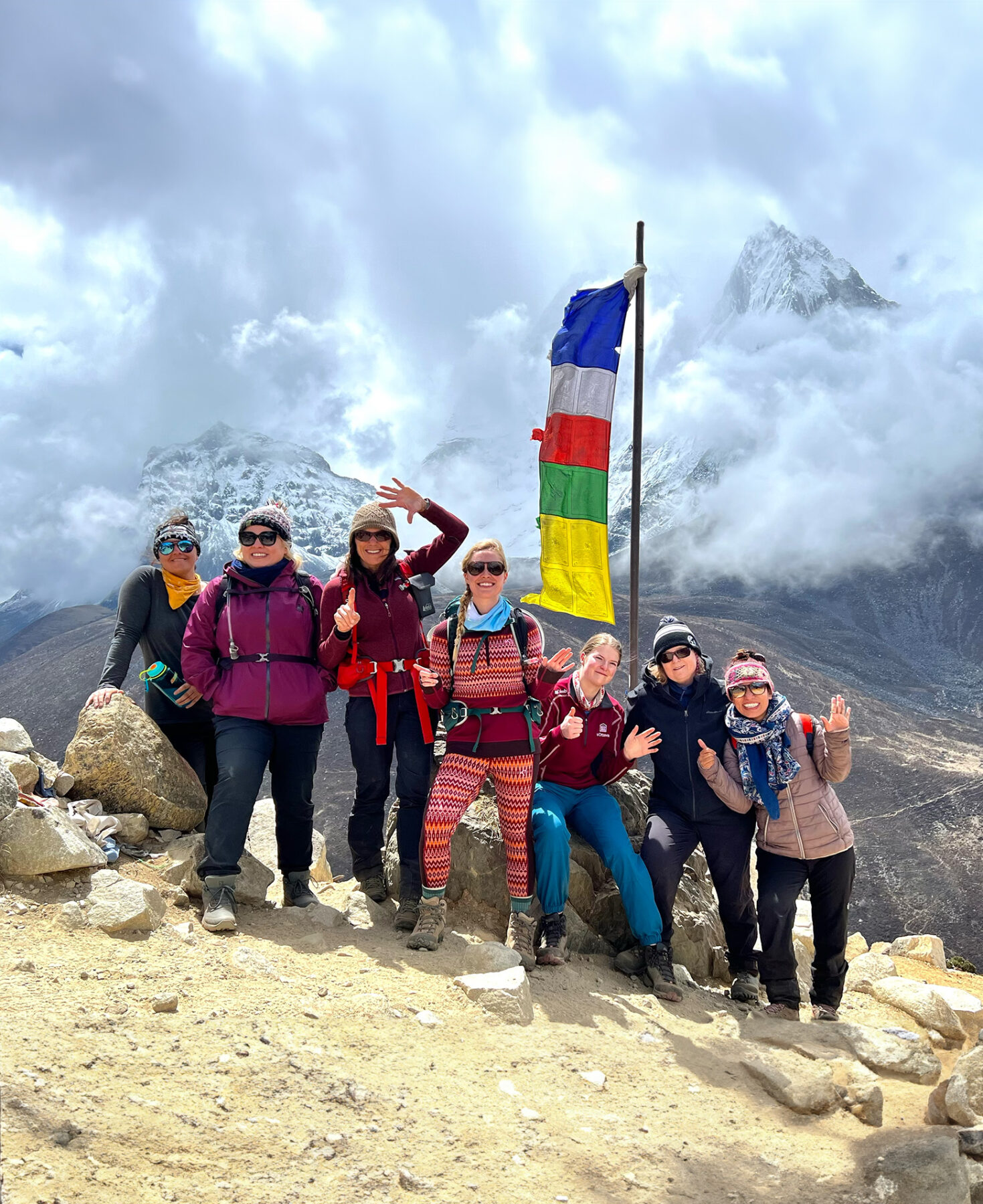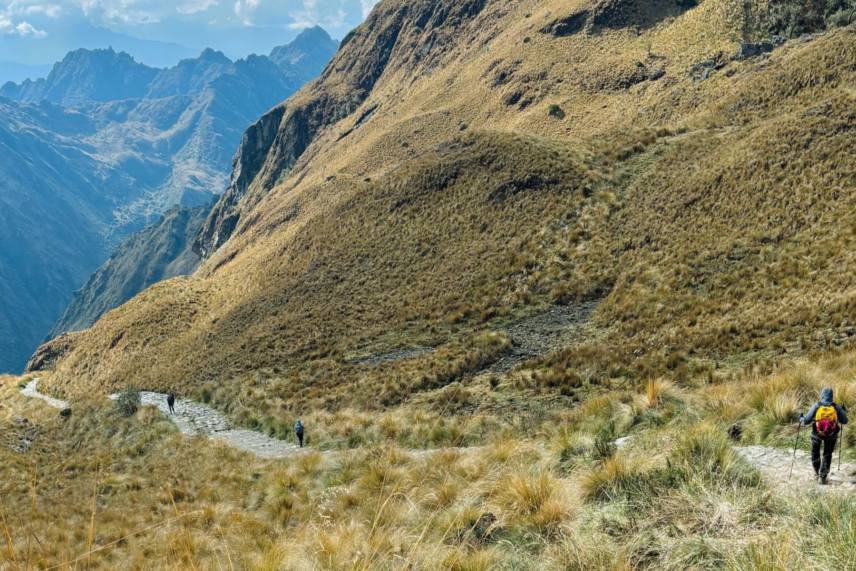
It was a profound connection to nature and history beyond anything I have ever known.
Hiking the Inca Trail to Machu Picchu is one of those adventures that stays with you long after you’ve returned home. It was physically demanding, emotionally moving, and filled with moments that are almost impossible to put into words. There was the sweeping beauty of the Andes, the ancient stone pathways beneath our feet, the stories of a civilization that built extraordinary things in the most unlikely places, and the quiet realization that we were part of something much bigger than ourselves.
Training for the Inca Trail Trek
I loved training for this adventure because I knew it would push me physically. There’s something satisfying about working toward a goal that may take you beyond your everyday limits. Every hike, every workout, and every hill climbed in preparation was an investment in the experience ahead.
I wanted to arrive feeling strong and ready, knowing that the trail would ask a lot of us. At the same time, I knew that no amount of training could fully prepare me for the altitude, the terrain, or the sheer magnitude of the landscape we were about to encounter.
And that was part of the appeal.
Some of the best adventures ask us to step outside our comfort zones, trust ourselves, and find out what we’re capable of along the way. But this trip was about more than the challenge. It was about the people we’d meet, the culture we’d experience, and the chance to explore Peru with Wild Women Expeditions. Travelling with a small group of women creates a particular kind of energy. It feels safe, inspiring, and somehow familiar, and it opens people up. Everyone arrives with her own reasons for being there, her own story, and her own sense of what the journey might mean.
I knew we wouldn’t all experience the trail in the same way, and I couldn’t wait to see what it would hold for each of us.


Cusco, the Sacred Valley, and a Living History
Our group arrived in Peru and spent the first few days exploring Cusco and the Sacred Valley before setting off on the trail.
It was an unforgettable introduction to a place where history doesn’t sit behind glass in a museum. It lives and breathes in the landscape, the architecture, the traditions, and the rhythm of everyday life.
We threw on chef hats for an in-depth chocolate-making workshop, explored the terraced archaeological site of Ollantaytambo, and met local women weavers supported by the Awamaki Collective in a small community just outside town.
Ollantaytambo is often called the last living Inca town, and it doesn’t take long to see why. Families still live behind walls their ancestors built more than 500 years ago, and water still runs through the original stone channels. Here, the past isn’t just something you visit—it’s something you actually walk through.
Meeting the women weavers was another highlight. Their techniques have been passed down through generations, and through Awamaki, their craft also creates real economic opportunity for women in rural Andean communities. It was a reminder that the best travel goes beyond sightseeing. It’s also about learning from the people who live there and understanding the traditions that still shape their lives.
Throughout those first days, our guide, Disnarda, brought the history and culture of the Andes to life. Her knowledge, warmth, and deep connection to the region gave every place another layer of meaning. By the time we packed for the trail, it felt as though our journey into another world had already begun.


The next morning, we would find out what the mountains had in store for us.
Finding Our Stride on the Inca Trail
We drove to Km 82 at Piscacucho, said goodbye to our driver, and stepped onto the Inca Trail. Sixteen kilometres stretched ahead of us that first day, but it didn’t feel like a distance to cover. It felt like the start of a pilgrimage.
Before we started walking, we paused to share our intentions for the journey. Each of us offered coca leaves to Pachamama, the Mother Earth figure at the heart of Andean spiritual tradition. In Quechua, pacha can mean earth, world, or even time and space, and mama means mother. Standing at the edge of that landscape, about to walk into it, we felt the weight of those words.
Then we set off. The trail followed the Urubamba River past small farming communities, cornfields, and tall stands of eucalyptus. With every bend, the valley widened, and the true scale of the mountains came into view.
Hiking changes the way you experience a place. When you’re walking rather than driving past, the small details come into focus. You feel every shift in the terrain beneath your feet. You notice the mountain air, the birdsong and rushing water, the changing light, and the steady rhythm of your own breath.
By late afternoon, we reached camp, set high on a hillside with green stretching in every direction. There we met our porter team, who would become such an important part of the journey. Their strength and dedication were remarkable, and the care they showed our group made every evening on the trail feel warm and welcoming.
As darkness fell over the mountains, headlamps flicked on one by one and we made our way to our tents. I crawled into my sleeping bag and lay listening to a quiet so deep it felt almost foreign, the kind you rarely hear when most of your life is spent in a city.
Silence under the stars. After just one day, the mountains were already feeling like home.


Dead Woman’s Pass, One Step at a Time
The next day brought the toughest climb of the trek: Dead Woman’s Pass, rising to about 4,215 metres (13,828 feet) above sea level. This was the highest point of our journey, and we felt it.
The climb was steep, and every step required a little more effort. Even with all my training, the altitude made it clear that this was a different kind of challenge.
You can’t rush a mountain.
You can only keep moving, find your rhythm, and focus on the next step.
What I leaned into most was the meditation of it all. There was no point worrying about how far we still had to go. All that mattered was the ground directly in front of me. One step at a time. Sometimes three steps at a time. And then another.
As we climbed, I found myself thinking about the different reasons each woman had come on this adventure.
One woman had dreamed of completing the trek since she was a little girl but had quietly worried she might not be able to keep up. She absolutely rocked it.
Another had come to rediscover her adventurous side after years of raising children. She met the challenge head-on.
Two women had met on a previous Wild Women Expeditions adventure and had been hiking around the world together ever since.
Another was fascinated by the region’s history. More than once, she filled in the bigger picture behind the ruins we passed, and her questions made us all want to know more.
And me? I was drawn to the deep connection between the Andean world and the cosmos. The Inca aligned their temples with the sun and the solstices. They saw the Milky Way as a celestial river, and they found constellations in its dark patches as well as in its stars, among them a llama, a serpent, and a fox. Even their world was layered: the condor for the heavens, the puma for this earth, and the serpent for the world below. Walking the trail, I could feel how closely the earth and sky were woven together in this place.
Each of us brought something different to the trail, and that was one of the gifts of travelling together.
Some women moved up the trail like gazelles, cheering everyone else on. Others found their own steady rhythm, calm and focused, taking the mountain as it came. We weren’t competing with one another. We were each having our own experience, while somehow sharing the same one.
And then there was the breeze. Whenever the climb felt overwhelming, a cool wind would sweep across us, like Pachamama’s breath arriving just when we needed it. Call it nature, timing, or a little bit of mountain magic.
The pass takes its name from the shape of the ridgeline, which resembles a woman lying at rest. Reaching the top was both exhilarating and humbling. The views were breathtaking, and so, quite literally, was the climb it took to get there.


Ancient Stones and Cloud Forests
If Dead Woman’s Pass tested our legs, the following day went straight to our hearts.
We climbed toward the ruins of Runkurakay, crossed Runkurakay Pass, and descended ancient Inca stairways to Sayacmarca, a striking ruin perched on a ridgetop. Further on, we passed through a tunnel carved into solid rock. I kept trying to imagine what it took to build all of this: moving stone through these mountains and laying paths that connected communities across such rugged terrain. Disnarda shared stories of Andean history and the people who travelled these routes centuries before us. Standing among the ruins, I could feel that history all around us. Not in an abstract, textbook way, but in a way that made the past feel close. The stones were right there beneath my hands and feet. The walls still stood. The paths were still leading us forward.
And then the landscape changed again. We entered the cloud forest, where everything felt lush, damp, and alive. Birds followed us, singing full, unbroken songs, which naturalists say is a sign they feel at ease. It was easy to see why. Tucked high in the mountains, this was their own untouched sanctuary. Butterflies drifted through the air, their colours flashing against the deep greens of the forest. The air felt startlingly pure, and the landscape seemed to hold an energy of its own. More than one of us was moved to tears.
I was especially struck by the butterflies. A fellow nature lover on the trek mentioned that many adult butterflies live for only a few weeks, depending on the species. I may have read that somewhere before, but in that moment, it really landed. Their lives are so brief, yet they seemed to move through the world with such lightness and joy, showing their colours without hesitation.
It made me think about how often we postpone joy until some future moment: when everything is sorted out, when we have more time, when we finally reach the next milestone.
What if we made a little more room for it now? What if we showed our colours more often, took pleasure in the small things, and let ourselves be fully present in the lives we’re already living? It might seem like a simple lesson to take from a butterfly, but standing there in the cloud forest, it felt important.
That night, we reached Phuyupatamarca, our final campsite on the trail. We camped above the clouds, looking toward sacred Salkantay, with llamas nearby and a sky so full of stars it seemed to stretch endlessly overhead.


Through the Sun Gate to Machu Picchu
Our final morning on the trail began with gratitude.
Before leaving camp, we gathered with our porter team for a tipping ceremony, a chance to thank them for the strength, encouragement, and care they had given us throughout the trek. They had carried so much more than our gear. Their work had made our experience possible, and it felt important to recognize that.
Then we began our descent.
The trail wound steeply through cloud forest, revealing unexpected orchids and leading us to the ruins of Wiñay Wayna and the terraces of Inti Pata. Everywhere we looked, there were reminders of the ingenuity and determination of the people who had built and travelled these routes.
After lunch, we continued along centuries-old stone pathways toward the Sun Gate.
And then the sun broke through.
Golden light was spilling over the peaks just as we arrived, as if on cue. And there it was: Machu Picchu. For a moment, none of us spoke. After days of climbing ancient stone stairs, dropping into cloud forest, and watching the terrain shift around every bend, we had finally reached the place that drew us here.
The mountains rose around the ruins. The stone structures sat within the landscape as though they had always belonged there. Clouds drifted across the peaks, shifting the light and revealing new details with every passing minute.
We gathered in a circle, and one of the women in our group led us through a meditation. It gave us a chance to pause, take in where we were, and appreciate the experience rather than rushing toward the next thing. I was grateful for that moment. We had spent days walking, climbing, and concentrating on the trail ahead. Now we could stop and let it all sink in.
As evening fell, we made our way down to Aguas Calientes for the night. Hot showers. A set-menu dinner. Real beds. After days in the mountains, those ordinary comforts felt luxurious.
The following morning, we returned to the sanctuary for a guided exploration of Machu Picchu. We wandered through the urban sector and the agricultural terraces and saw the stone solar clock linked to the Incas’ understanding of the sun and sacred time. Machu Picchu is stunning in photographs, but no photograph can convey what it feels like to stand there: the scale of the mountains, the texture of the stone, the drifting clouds, and the sense of history held in every wall.
When it was finally time to leave, I watched the valley slip past the train window and thought about everything the trail had asked of us, and everything it had given back. We had arrived as a group of women, each with her own reasons for being there. We left having walked every step of it together.
The trail was behind us. But what it taught us—to trust the next step, to make room for joy now, to stop and let it all sink in—was coming home with us.
Some adventures change the way you see the world. This was one of them.


Ready to take your first step? Explore our Inca Trail Trek to Machu Picchu and discover more women’s hiking adventures around the world.