I recently spent a week aboard the National Geographic Delfina on Wild Women Expeditions’ Galápagos Yacht Adventure. This is what happened when I traded my inbox for iguanas.
A Galápagos Arrival Decades in the Making
When I arrived in the Galápagos Islands today, I had to pinch myself. The air was thick with the scent of salt and sun-baked volcanic rock, a sensory trigger that made everything feel real. This is a place I’ve been dreaming of visiting since I did a research project on blue-footed boobies back in grade 3! Standing on the tarmac, I felt that childhood wonder rush back. I’ll be joining an expedition on the National Geographic Delfina this week—the lovely catamaran Wild Women Expeditions is chartering with Lindblad Expeditions in November 2026, February 2027, and two more expeditions in 2028 and 2029.
Stepping onto the Delfina felt like entering a private sanctuary. We met our dedicated crew of 8 plus our awesome expedition team, Vanessa and Karina, who will be looking after our small group of 16 passengers. The ship itself is a marvel of design, balanced and stable, offering the perfect platform to explore these remote waters. There is an immediate sense of camaraderie among the group, a shared excitement for the biological miracles waiting just offshore.


First Splashes in Isla Santa Cruz
Our first outing was a zodiac cruise to a lush mangrove cove on Isla Santa Cruz. As we glided silently, we spotted pelicans perched like guardians on the branches, more blue-footed boobies, and over a dozen green Pacific sea turtles breaking the surface for air. Below the waterline, the world was just as busy; we saw parrotfish with their neon scales, spotted eagle rays gliding like ghosts, and two species of shark—the “baby kind” that looked more curious than predatory. Pufferfish, sea bass, and the stoic lava heron rounded out our list. And that was just a short late-afternoon cruise.
After a delicious dinner on board, featuring local seafood and fresh produce, we gathered on the deck. The ship’s lights illuminated the dark waters, revealing a nightly drama: sharks feeding on schools of fish right off the hull. The energy was electric. Tonight, we weigh anchor and cross the equator north to Isla Genovesa. We are heading for hiking, snorkeling, and kayaking in Darwin Bay tomorrow. Fingers crossed for a smooth overnight crossing as the Delfina handles the swells.
Naturalist Guides And Evolutionary Echoes
If you’re one of the women signed up for WWE’s Galapagos Yacht Adventure this fall or in February 2027, wow, are you in for an incredible experience. The magic of this trip isn’t just in the destination, but in the interpretation. Our guides Vanessa and Karina, local women from the Galápagos, possess a great passion for their home and are eager to share their vast knowledge of this incredibly unique environment. Their stories turn a bird on a rock into a masterclass in adaptation.
Everything here is about survival and adaptation—which is why there has been so much ongoing research on the wildlife and ecosystems since Darwin arrived in 1835. As we walk the trails, Vanessa points out the subtle differences in finch beaks, while Karina captures the light hitting a marine iguana. The stories of evolution are fascinating, and hearing them from women who have lived their lives among these creatures adds a layer of depth you simply can’t get from a textbook.

The Northern Frontier: Genovesa and Sullivan Bay
In just three days, we’ve already checked off dozens of species during our zodiac cruises, hikes, paddles, and snorkeling sessions. Isla Genovesa, one of the most northerly and pristine islands, felt like a scene from another era. We hiked up to a vast plateau to view the red-footed boobies—home to the largest colony in the world—and Nazca boobies. Seeing them nesting so closely to the trails was a reminder of how unafraid the wildlife is here. We even spotted short-eared owls hunting storm petrels in broad daylight, a rare behavior born of the island’s unique lack of predators.
We did our first cliff-side snorkel, feeling the surge of the ocean as we looked for life in the crevices of the caldera. Later, we enjoyed a late-afternoon stroll among napping sea lions who barely acknowledged our presence. Sailing back down across the equator overnight was a “rock and roll” journey, but the Delfina’s twin hulls kept us comfortable as we made our way to Sullivan Bay. Here, the landscape shifted dramatically. We hiked across a massive plain of pahoehoe lava formed from an eruption in 1897. The ropey, obsidian-colored surface looked like a natural art sculpture stretching as far as the eye could see.


Fernandina and Isabela: Penguins, Photography, and Volcanic Vistas
The snorkeling along the Sullivan Bay coast was a highlight. To our absolute delight, a Galápagos penguin swam circles around us, darting through the water like a feathered torpedo as it hunted for lunch!
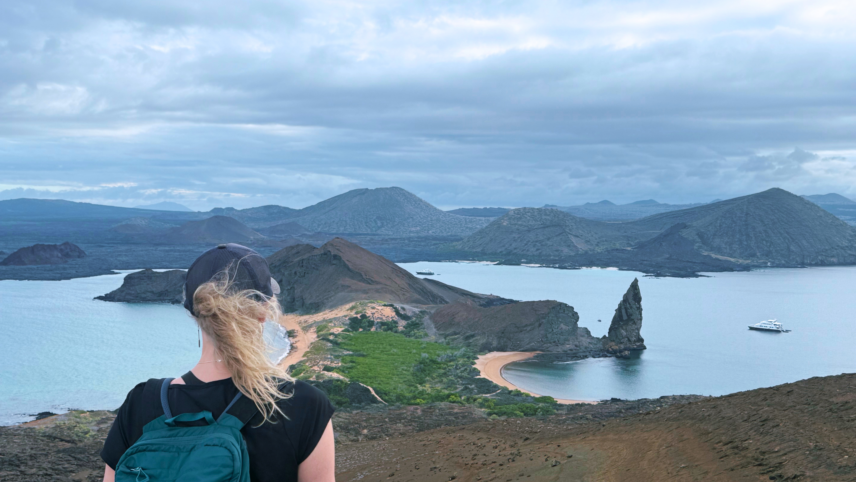
After a midday feast of fresh ceviche and panini sandwiches, we took some “chill time” on the deck. The afternoon was dedicated to a photography workshop led by Karina, who is a certified National Geographic photographer. She taught us how to frame the stark contrasts of the islands before we tackled the 372 steps of Isla Bartolomé. From the lighthouse at the top, we looked back at the great lava field we had hiked that morning, framed by the iconic Pinnacle Rock.
Evening on the Delfina is a time for reflection. We spent one night stargazing on the upper deck, watching the Milky Way blaze across the sky while sharks and sea lions competed for flying fish in the water below.
We eventually sailed south along the coast of Isla Isabela to Isla Fernandina. Fernandina is the youngest and most volcanically active island, hosting a massive population of marine iguanas. Watching these “little dragons” swim and sneeze salt was mesmerizing. We also visited sea lion nesting grounds, where tiny, brand-new pups called out for their mothers—a heart-melting sight that emphasized the cycle of life here.


Gentle Giants and Mangrove Secrets
We stopped at Urbina Bay for a walk through land iguana and giant tortoise habitat. Seeing these ancient, sleepy tortoises along the trail was a profound experience; they carry a weight of time that is hard to describe. There are over 15 known species of giant tortoises in the Galápagos, each evolved for its specific island.
After a reposition to Isla Santiago, we explored Puerto Egas and Buccaneers Bay. The tide pools here were teeming with life, and we were thrilled to add several species of rays to our list of snorkel sightings. To cap it all off, Karina surprised us with a compilation of underwater footage she had captured throughout the week. Seeing our adventures from her professional lens was the perfect gift.
Our adventure culminates with a full day on Isla Santa Cruz, grounding us back in the hub of Puerto Ayora. We’ll wander the iconic Charles Darwin Research Station, where the history of these islands comes alive and where we can witness conservation firsthand at the giant tortoise breeding center.
Afterward, we head into the lush highlands—the perfect finale to spot giant tortoises in the wild, watching them roam freely in their natural habitat, a poignant reminder of the conservation efforts that protect this enchanted archipelago.


Why This Journey Matters
If exploring the Galápagos is something you’ve always dreamed of, consider the unique rhythm of a yacht adventure. Navigating by catamaran allows you to reach the remote corners of the archipelago where the largest ships can’t go. The days are filled but never rushed; the activities are exhilarating but not overwhelming. You aren’t just a tourist here; you are an observer of an ongoing evolutionary experiment. Traveling with a group of women fosters an environment of support and shared joy that makes every wildlife sighting feel like a collective victory.
From the blue-footed boobies diving like arrows into the sea to the great frigates coasting above the bow, the Galápagos offers a perspective on the natural world that you simply won’t find anywhere else. The food is local, the sunset happy hours are legendary (with sunset views at ~6:00 PM every single day of the year!) and the comfort of the Delfina makes the rugged landscape feel like home. There really is no other place on earth like this.
Join Our Galápagos Yacht Adventure
Wild Women Expeditions has several upcoming charters scheduled, and there are still a couple of berths available this year on the November 27–December 6, 2026 expedition! (2027 dates are also open for those planning further ahead). If you’ve been waiting for a sign to book that “bucket list” trip, this is it. Contact the Wild Women Expeditions office today to secure your spot on the National Geographic Delfina. The islands are waiting!