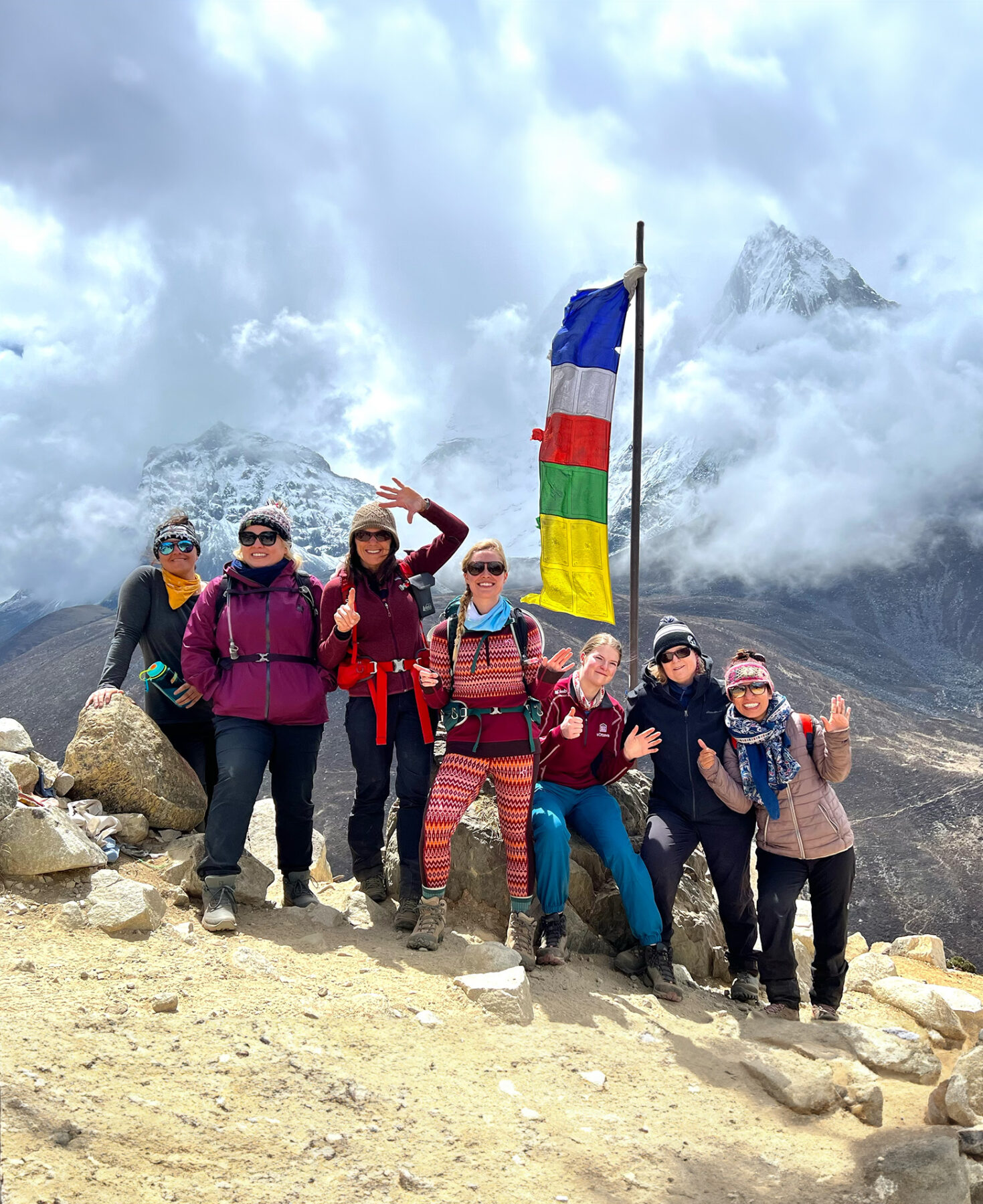
Being a Wild Women Expeditions host on a Small Ship Expedition means I wear a few different hats. One of those hats I left on Sable Island—along with a piece of my heart.
On the Sable Island Small Ship Expedition a few summers ago, I was holding my breath in the bracing breeze on the top deck of the Ocean Endeavour as we prepared to sail out of St. John’s harbour at the start of the trip. With the narrow neck of the harbour and the gathering winds, we had only a small window to leave the harbour and make our way to Sable Island, over 400 miles away. If we had to wait out the weather in St. John’s for a day, we’d miss our window of good weather for landing on the island. Our Expedition Leader had been watching the weather closely all day and was contemplating doing the whole trip in reverse in hopes of having favourable conditions for landing on Sable Island at the end of the trip. But there are no guarantees when it comes to this tiny remote desert island.
Sable Island is a 26-mile (42 km) long sandbar, shaped like a narrow smile, 109 miles (175 km) off the coast of Nova Scotia in eastern Canada. The island exists solely because of the currents that continuously form and re-form the shape of the island as it creeps slowly toward the continental shelf. Those same currents make the surf around Sable Island particularly choppy, and the island is notorious for snubbing its would-be visitors.
(Read more of Sable Island’s unique history here).
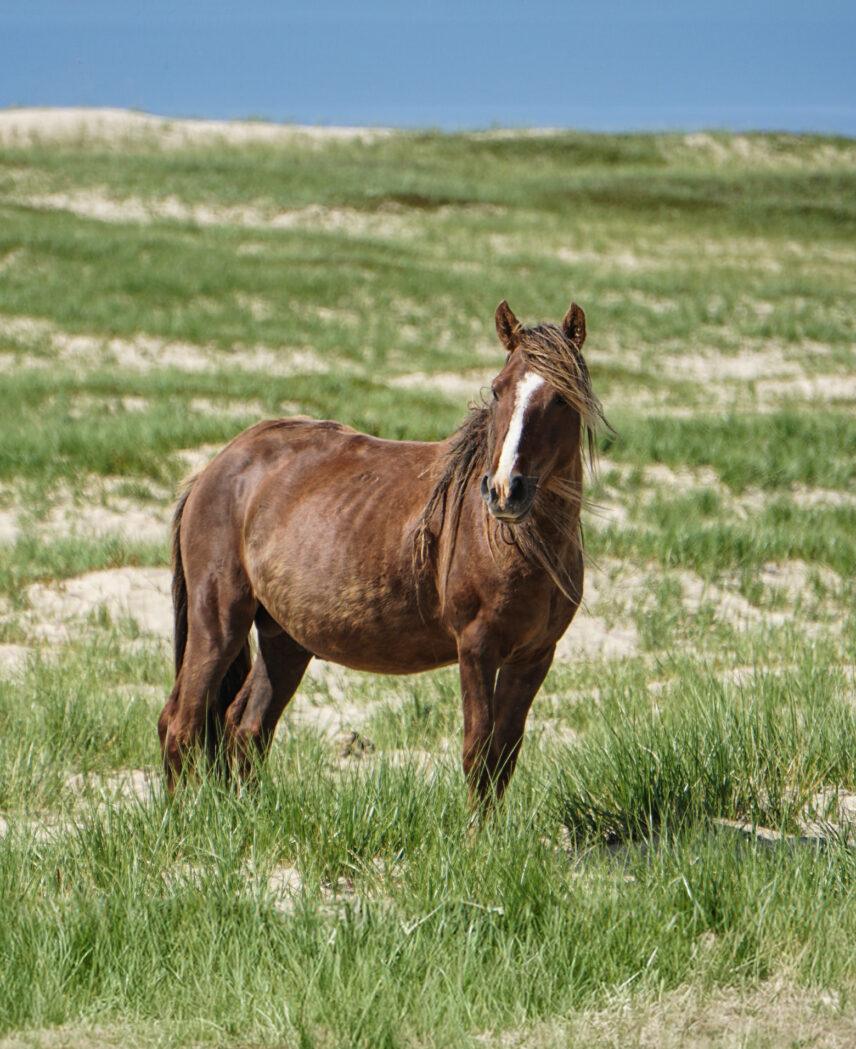
Despite the challenges of getting there, Sable Island remains a captivating destination. Whether it’s the chance to see wild horses or to explore the untouched landscapes, there’s an undeniable magic to Sable Island.
The island’s magic allure, along with an insatiable curiosity, drew Zoe Lucas to visit the Sable Island in 1971 and return in 1974 to make it her home. She has solved the problem of the difficult access to the island by not leaving any more than she has absolutely had to in the past 50 years.
Meet Zoe Lucas
Zoe first visited Sable Island in 1971. When I ask her what drew her to the island in the first place, she has a fascinating story to share with me. She tells me of her young, wild nature and a dream she had of visiting a certain remote island in the North Atlantic, then hardly known, but has since become one of the most popular tourist destinations in the world: Iceland.
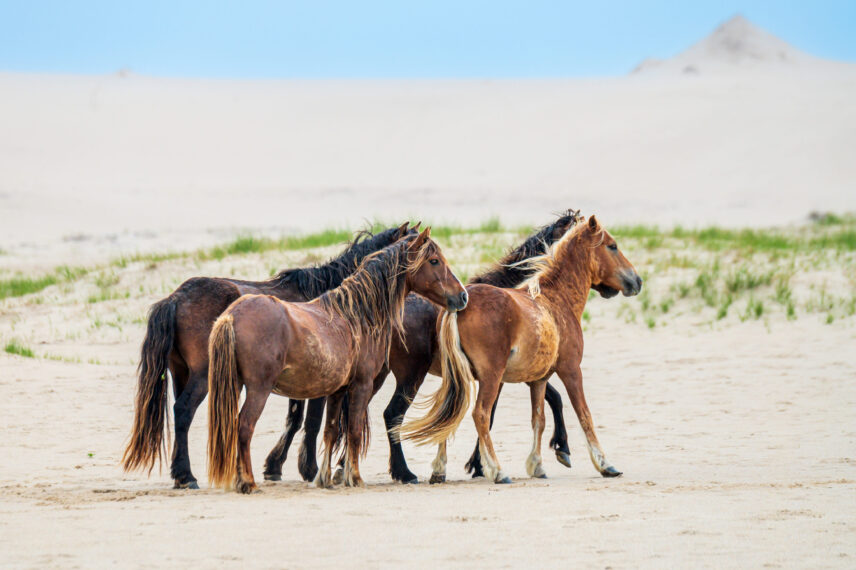
While Iceland has grown in popularity with tourists over the years, Sable Island’s population has remained fairly steady, with rarely more than a dozen inhabitants at any given time. Unless you count horses, of course. This year’s estimate of the horse population on Sable Island is a little under 400, and it tends to fluctuate from about 350 – 600, depending mostly on the winter conditions of that year, and how many survive the harsh, cold, wet, windy winters there.
As a twenty-year-old with a big vision, Zoe shared her dream of going to Iceland with a woman she met. Katie hadn’t been to Iceland, but she had spent time on another isolated island in the Atlantic: Sable Island. Social Services had sent her there as a place to escape and recuperate from challenges at home, and Katie described the island as a wonderful, wild and peaceful place. She suggested that Zoe might be interested in visiting Sable Island, which was home to hundreds of wild horses. As a horse-loving young woman, Zoe’s ears perked up, and she was soon packing her bags for her first visit to the elusive and remote island.
It was love at first sight, but after that visit, it would be three more years before she would return again. According to Zoe, Katie herself never returned to Sable Island, despite her lifelong yearning to do so. Zoe, on the other hand, has rarely left the island since her return in 1974. In case she might be separated from her beloved island again and unable to return, Zoe has mostly stayed put.
When I ask Zoe why it took her three years to return, she stops walking and turns to me with a twinkle in her eye. She says, “I suppose that it wasn’t the thing for young girls to be gallivanting around unchaperoned in those days!”
Young Zoe was not one to be deterred from her dreams. When a position came up as a volunteer cook on the island with its small shifting population of mostly researchers and biologists, Zoe jumped at the chance to return. She would be cooking for a group of seal researchers. There was ample free time between cooking simple meals, and soon she was accompanying the researchers in the field, recording their findings in small notebooks, continuing the work when they left the island and adding observations of a growing number of species to her books.
Fifty years later, she spends her time documenting every aspect of the island’s flora and fauna, flotsam and jetsam, as well as weather and other data. Her notebooks have expanded into 8000 pages of handwritten notes, drawings, and several detailed spreadsheets.
When we first meet Zoe, she is a little reserved, maybe even a bit shy. Ten of us had signed up for a “Contemplative Walk” with Zoe. No one was really clear what that meant, including Zoe herself, so we started out on the beach where she said we could “contemplate this horse skull” and then told us how she’d been carrying a horse skull when she tripped; her hand had gotten bitten when it got caught in the jaws.
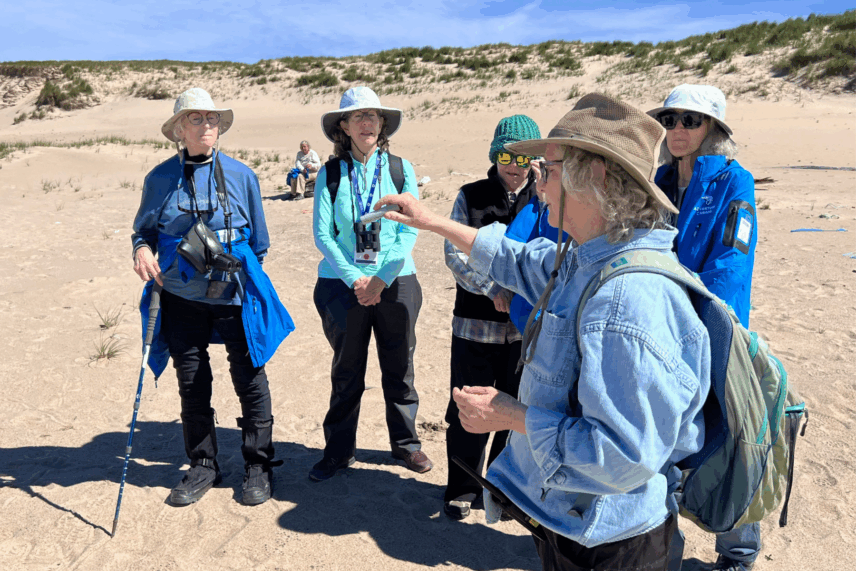
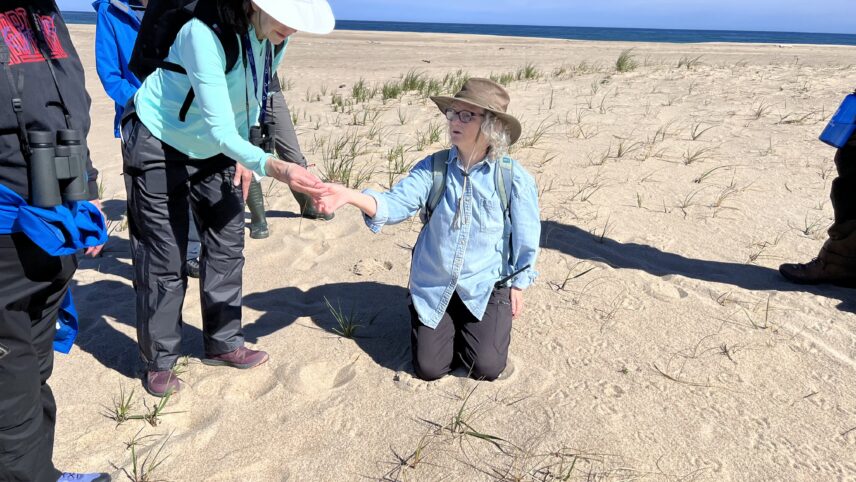
At 74, Zoe moves through the sand like someone much younger, dropping to her knees regularly to inspect a tiny bug or another object. She says, proudly, that she’s “the oldest living organism on the island.”
As we walk inland together, she tells us about the grasses, vegetation, even horse dung and wolf spiders; she starts to shine and flow in a whole new way. She is so obviously in her element that she practically skips along the sand.
She stops at a clump of grass that appears to be dead, but which is still standing out from the sand. She drops to her knees, filling her socks and sandals with sand, then plucks a strand of grass from the sand and holds it up to show us it has no roots at all. She explains that there’s a type of larvae that eats the roots. She says that some people want to demonize the larvae and try to eradicate them because the grass holds the sand in place, and without it, the island would soon blow away. However, when the grass dies, it decomposes, creating organic matter for more vegetation to grow. So, it’s both bad and good.
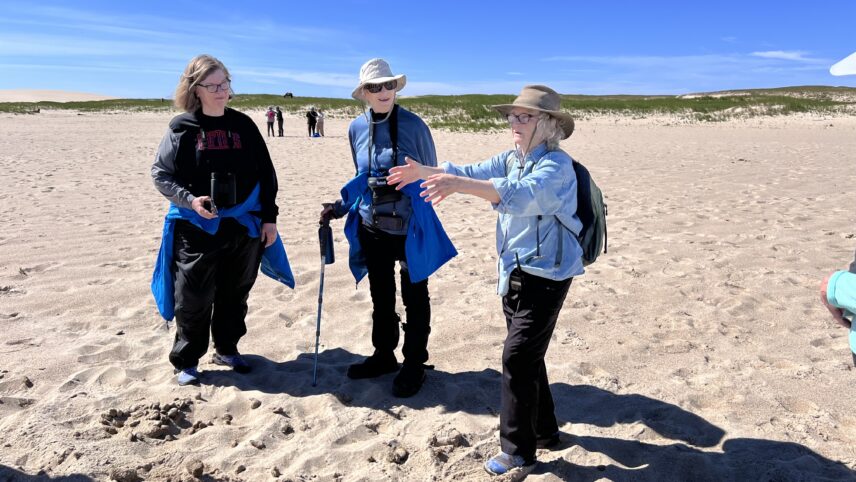
I sense in her explanation an underlying personal philosophy and a deep trust in the wisdom and equanimity of Mother Nature.
Suddenly, in the middle of explaining the life cycle of the wolf spider living in the horse dung that we’re contemplating, she turns 180 degrees and points at a clump of tall grass and says, “Ipswich sparrow.” The tiny brown sparrow nests only on Sable Island and is hard to see at the best of times, but she has spotted it from behind her back while looking down in the opposite direction. We take pictures of the elusive, highly camouflaged little bird before continuing to observe the pile of stallion manure and learn how they mark territory with feces.
I ask Zoe if she lives on the island year-round, and she sighs. “Since it became a National park in 2013, I have to leave for a couple of months in the winter. I have an apartment with a roommate in Halifax, but I’m almost never there. Sable Island is my home.”
She asks about Wild Women Expeditions, and I tell her that we have a group of 25 women aboard the ship, and we eat meals together, plan excursions together and have special receptions and programming just for our group. I share Wild Women Expeditions’ philosophy and our focus on fostering supportive group environments. As she listens, she lights up and says, “I think I’d like something like that.” I tell her, “We’d love to have you. And, in fact, you would be an incredible addition to the expedition team for this trip, with your deep knowledge of Sable Island.”
She looks around herself in a big sweeping circle, and says, “Well, I’ve been asked to join the expedition team before. But then I’d have to leave the island. And, if I leave the island, I have to have a two-week window open for when I can return.” She’s referring to the difficulty of getting to the island with its unpredictable conditions. “If I left for two weeks and couldn’t get back for two more weeks, I’d lose a whole month. I wouldn’t want to miss that much time.” I nod, look around at the wild natural beauty of the place, and have to agree. I’m also grateful for the sturdy Zodiacs that deliver us to and from the ship, even in conditions that might hinder other craft from accessing the island.
I tell her that I understand, and that she is every inch a wild woman to her core, whether she joins a trip or not. She nods and smiles, with the gentle confidence that I’ve come to see in her throughout our time together.
Our tour comes to an end too soon, and we gather for a picture by the Sable Island Parks Canada Sign and the signature red chairs. I hug Zoe and thank her for the tour and the chat, and start preparing for the Zodiac ride back to the ship. It’s a warm day, but I’ve packed my Wild Women Expeditions beanie (toque, for Canadians) in my dry bag, just in case. Without a second thought, I pluck it out of my bag and run back to where Zoe is standing, and offer it to her. “You should have a Wild Woman Expeditions hat to keep you warm out here on those cold, windy days.” She graciously accepts my gift and looks truly pleased. She says that she actually needs a new hat and will wear it.
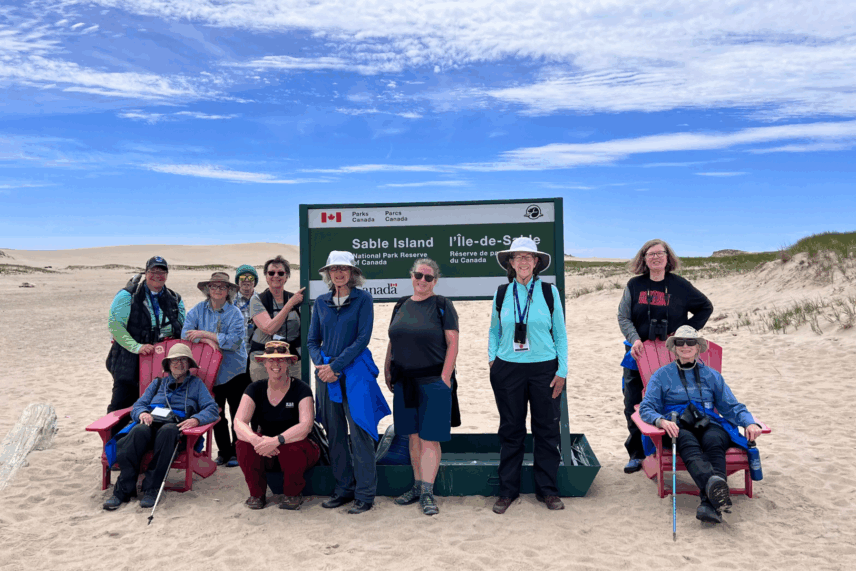
And that’s how I left my hat and a piece of my heart on Sable Island.
Our time on Sable Island was just the beginning of an epic voyage that ended in St. Pierre and Miquelon, France, before a quick flight back to St. John’s, Newfoundland, where our adventure began. In between, we visited the Bird Islands, Cape Breton Island, Prince Edward Island, the Magdalen Islands, and the south shore of Newfoundland, and enjoyed stunning views and a fabulous East Coast welcome in every port.