Our team member Julie-Anne spent two weeks with a small group of women, exploring Egypt’s history and heart. This is her story.
Sitting around the dinner table on Day One, I felt a twinge of imposter syndrome. Even before boarding the plane to Egypt, I knew I was going to be both underprepared and overwhelmed by the sheer amount of information we would consume over our two week journey on the Wild Women Expedition’s Ultimate Egypt women’s small- group adventure, but alas, here I was.

What Small-Group Women’s Travel Through Egypt Actually Looks Like
Of ancient Egypt, I knew next to nothing. I knew of the Pyramids. King Tut. Luxor. Yes, I had heard these names, but my education had never really steered me much deeper than that.
On day one, as we introduced ourselves, I quickly discovered that my travel companions seemed to have one thing in common: they had a passion for ancient Egypt, and they could talk the talk.
Names of pharaohs, queens and temples were thrown around casually. I couldn’t help but feel both impressed and a little bashful about my lack of knowledge. Lucky for me, no Wild Woman trip requires you to have a specific level of knowledge before going.
This is precisely where our incredible guides come in.
Shery, our guide, had won the hearts and respect of our group from the moment she began to speak. Not only was she a scholar of ancient Egypt, but she shared her vast knowledge with us in the form of stories so engaging that, when she spoke, we listened.
She had a way of making 5,000 years of human history feel like a gripping screenplay where you couldn’t wait for the next scene to unfold. And she knew every scene, every player and every landmark – intimately.


Standing atop a sand dune, I stared across at the Great Pyramids of Giza. I closed my eyes and took in a slow, deep breath, trying to sense the energy of those who had also stood here over the last 5,000 years.
I could hear the grunts of nearby camels and smell hints of spice in the air. I opened my eyes and could see carts pulled by donkeys and camel trains weaving their way through dunes at the base of the pyramids.
Was this scene any different from what those who have stood before me over thousands of years would have seen?
Were the sounds and smells the same?
How different, or similar, are we from the women who have witnessed the pyramids over the ages?
This concept of time, and our questions surrounding it, we discovered, would keep surfacing as a central theme throughout our journey.


Egypt’s History, Up Close
The first few days were a steady exploration of archaeological sites, stories of ancient royals, buried treasures and lost scripts.
We moved through colossal temple labyrinths. We went underground into low-lit tombs and craned our necks to admire ancient carvings on gold plated ceilings. We walked every floor of the brand new Grand Egyptian Museum (GEM), the largest archaeological museum in the world dedicated to a single civilization.
We stood dwarfed by enormous statues, trying to comprehend the thousands of years of human civilization they represented.
Egypt is a land of contrast. It is either desert or oasis. What I hadn’t appreciated until we flew south from Cairo to Luxor was just how vast the desert is, and how narrow the fertile corridor is where the bulk of Egyptian life and history has taken place.
From the air, the narrow strip was clearly pronounced: a ribbon of life running through an otherwise immense landscape of desert. The relationship between the river and life became unmistakable.
The Nile wasn’t simply a river.
It was — and remains — the lifeline of Egypt.
And this is exactly where the beauty of traveling by Dahabiya comes in.


Meeting the Women Shaping Egypt Today
One of the hallmarks of our Egypt trip is just how perfectly balanced it is.
At precisely the right moment, mid trip, we stepped aboard our 16-passenger floating home, the Royal Cleopatra, our Dahabiya.
Switching gears from our fast paced dive into ancient Egypt, we took a deep breath and settled into the next five days of slow-paced immersion into present-day Egyptian life.
Time onboard was spent lounging, sipping cool drinks, journaling, napping, reading books and simply watching life go by. Time off our ship was anchored in shallow bays, tied up alongside small villages visiting places that larger ships could never access.
And over those five days, we did a tremendous amount of all these things.
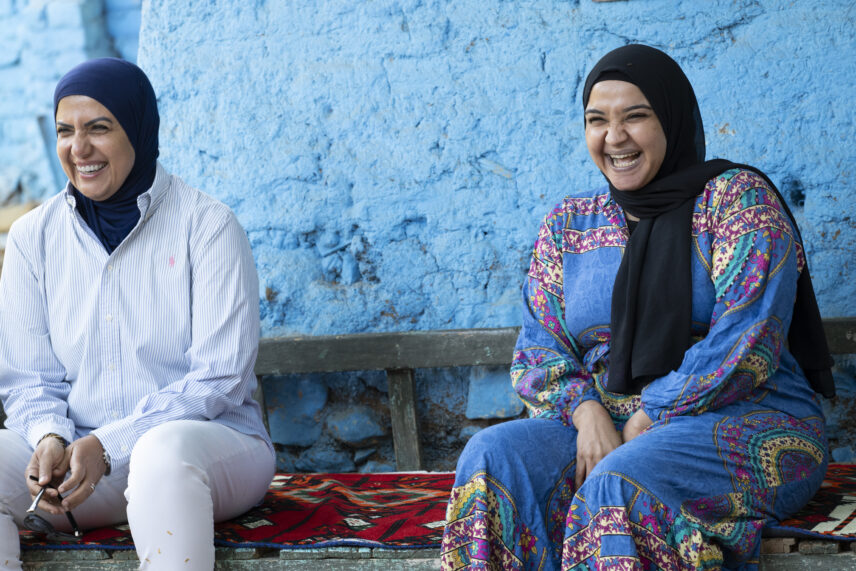
We went from learning about the women of ancient Egypt to being invited into the homes of inspiring women of present-day Egypt.
We ate breakfast with their families and toured their small villages. Learned to bake fresh bread in their wood fired ovens. Drank tea with their grandmothers. Laughed with their children.
Twirled on dirt dance floors to the rhythm of their Egyptian drums. Prepared delicious food in the home of a wise and welcoming Nubian woman.
We spent an afternoon with a local village guide at a camel market where we were the only foreigners among hundreds of camels and traders who had crossed deserts and mountains to buy, sell and trade their animals.


If there was ever an Indiana Jones travel moment on one of our trips, this was it.
Monkeys and camels milled about freely, while local traders smoked hookah and bargained loudly. The local village was saturated in the scent of spices, fish, freshly baked bread and Arabian coffee.
Eventually, we sat down in a busy corner café and quietly watched Egyptian life unfold around us.
Our days along the Nile were packed with deeper, slower, beautiful travel moments. Each of these precious moments were made possible thanks to Shery. Whether interpreting thousands of years of human history or facilitating moments of connection – Shery was an absolute master.
A few days later, watching the sun set as we sailed up the Nile, once again, our conversation turned to that of time.
The crimson sun was low in the sky, framed between the tower of a nearby mosque and the silhouettes of palm trees. The call to prayer echoed across the water and out into the desert beyond.
A local fisherman paddled past on a bamboo raft. Behind him were men in long robes on all fours praying, while their children ran in and out of the water, splashing and playing in the fading light of day.
Earlier that day, we had swam, our bodies warmed by the African sun, in these same waters that had sustained the women of ancient Egypt.
The air was warm and smelled of amber incense and wood-fired ovens, carried to us in a soft Egyptian evening breeze – echoes of an ancient world permeating our present moment.
What were the women who lived and sailed along this river thousands of years ago feeling as they basked in this breeze? What were they thinking of as they watched the sun go down in this same spot?
The life-giving water of the Nile continues to flow, sustaining life over the course of thousands of years, and with all hope, will continue to do so for all time.
Very reluctantly, we disembarked from our Royal Cleopatra after five beautiful days, already nostalgic for the slow and deeply present sense of life on the river. We had reached as far upstream as we would go, and from here we had one last major visit before flying back to Cairo.

What Stays With You: Egypt’s History and Its People
In keeping with the balanced nature of this trip, we transitioned one last time out of our immersion in present-day life and travelled back to ancient times.
To Abu Simbel.
Built 3300 years ago, Abu Simbel’s temples represent one of the world’s most remarkable engineering feats, having been relocated in the 1960’s piece by piece to higher ground to save them from the rising waters created by the construction of the Aswan High Dam.
As a symbolic grand finale to our exploration of ancient Egypt, we attended an outdoor evening light show at the temples of Abu Simbel. Witnessing a modern laser show against a backdrop of mind-bending antiquity was overwhelming to say the least. It was an experience that moved our group, deeply.
And yet, looking back now, I realize that the pyramids, the tombs, the temples and light shows – while fascinating – were not ultimately what gave this trip its deepest meaning.
I arrived in Egypt thinking the goal was to understand its past. Instead, I found myself connecting even more with its present.
I went looking for ancient Egypt, but what resonated the most was time spent with the women we met along the way. The women who welcomed us into their homes. The grandmothers who poured us tea. The mothers who shared their food. The women who taught us, fed us, laughed with us, danced with us and invited us, however briefly, into their everyday lives.
They became the bridge between the Egypt of 5,000 years ago and the Egypt in front of us today.
And perhaps that is the lesson that was buried in our reflections on time. Civilizations change. Languages, customs and cultures evolve. Kingdoms rise and fall. Temples become archaeological sites. Stories become legends.
But there are things that seem to transcend time.
I began to wonder less about how different we are from the women who lived here then — and more about how remarkably similar we just might be.
The strength of women.
The instinct to nurture. To connect.
The desire to gather, to share food, to tell stories, to laugh, to teach and to welcome, with open arms.
The wisdom that is passed from one generation to another.
These qualities that women possess – they are timeless.
Long after a trip like this ends, it is the human interactions that stay with you.
They remind you of the innate beauty and wisdom that we, as women, share — no matter where we are on this globe, and no matter where we stand in the long line of human civilization.
Egypt gave us thousands of years of history.
But it was its women who gave that history a heartbeat.
And perhaps that was the piece of Egypt I didn’t know I was looking for.