A New Chapter in the North
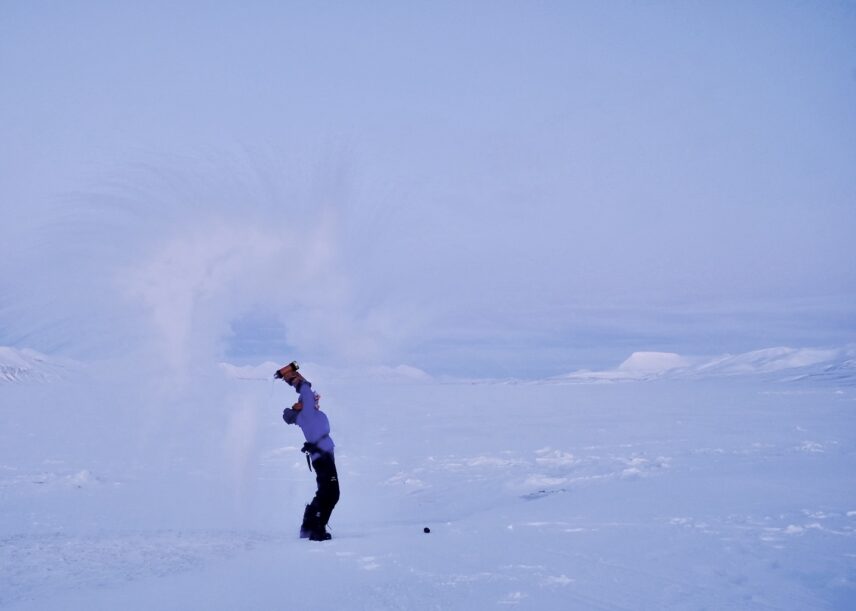
In June 2026, I’ll return to Svalbard as the Polar Ambassador for Wild Women Expeditions. The Arctic has long been my classroom—from guiding expeditions in the Canadian Arctic and Svalbard to skiing across the Greenland Icecap and, in 2019-21 spending nineteen months overwintering at Bamsebu- a tiny cabin never to be found on AirbnB, during our Hearts in the Ice expedition as the first women to overwinter in Svalbard and collect data for science as “ citizen scientists”. We connected with over 100k youth around the world, taking them from climate despair to hope. That experience at Bamsebu taught me the importance of routine/ritual, stillness, and what true connection means.
My focus now is on helping reshape who leads in the world’s most remote and fragile places.
Wild Women Expeditions’ expansion into polar offerings isn’t about adding new destinations—it’s about transforming who participates and who holds the compass. The future of these regions depends on diverse leadership, and they are creating real pathways for women to step into expedition and scientific leadership roles across the Arctic and Antarctic.
They also recognize their influence within the expedition cruise industry, a sector historically dominated by men. Wild Women Expeditions is helping change that. They actively champion the inclusion of women in leadership positions on the expeditions you join—especially as Expedition Leaders and Assistant Expedition Leaders—and proudly celebrate and spotlight these women when they are appointed.
For the upcoming Antarctic Women’s Expedition aboard the Sylvia Earle, they have formally requested and are strongly advocating for a predominantly female Expedition Team, and we expect to see significant female representation. This is more than symbolic; it’s systemic. A core part of my mission and collaboration with WWE is to help reshape the traditional, male-dominated narrative of polar exploration—replacing conquest with collaboration, competition with compassion.
Why I Travel
I travel because movement invites reflection. Because awe—yes, that rare, humbling sensation of standing before something vast—rearranges the furniture of the heart. And do I ever like re-arranging furniture. I travel because curiosity keeps me alive.
In Antarctica, I learned discipline: one step, one breath at a time. In Svalbard, I learned stillness despite the constant pre-occupation of Polar bears and 6 months of total darkness (Svalbard descends into the Polar Night at the end of October when the sun dips below the horizon more than 5’). In the Canadian Arctic, I learned humility and reverence from the Indigenous women who hold up their communities to the bounty and lessons of the land. Each place demanded something different of me, and each time I returned home changed—not by what I saw, but by how I saw.
If you can’t feel it, you can’t heal it.
That simple truth, written in my Arctic journal on one of those long polar nights, helps guide everything I do.
The Shift to Transformational Travel
There’s a growing movement in adventure and ecotourism called transformational travel—journeys that change not only where we go, but who we become. It’s more than sustainable travel; it’s intentional travel. It’s about choosing experiences that awaken empathy, curiosity, and care.
As an advisory member of the Transformational Travel Council, I believe in its core principle: “Transformation begins inward, then ripples outward.”
When I guide in the polar regions or speak to students and adults about citizen science, wildlife and our natural world, I’m not offering information—I’m offering transformation.
I want them to feel the why behind the what:
Why protect what we love?
Why bear witness to melting ice?
Why keep believing in possibility when the headlines tell us not to?
Because connection changes everything. When we fall in love with a place, a community, or a cause—truly and viscerally—we protect it.

Travel as a Mirror of Our Humanity
Travel, at its best, isn’t about escape—it’s about belonging.
Transformational travel isn’t always easy. It asks us to surrender control. You can’t hide behind certainty when your ship is surrounded by shifting ice or when a katabatic wind howls across Antarctica. You learn to let go—to trust.
I’ve seen this again and again—teachers, scientists, CEO’s and dreamers standing on the deck of a ship, watching a glacier calve or a whale breach. There’s laughter, silence, and sometimes tears. Then comes awe—and that awe becomes a moment seared into the soul. It can also be fuel for action. I live for those moments of awe -and sharing them is all the more special.
The Role of Tourism—And Women Within It
Tourism employs one in ten people globally. Yet, according to the UN World Tourism Organization, women—though they make up the majority of the tourism workforce—are often concentrated in the lowest-paid roles and perform vast amounts of unpaid labor.
UN Tourism Secretary-General Zurab Pololikashvili reminds us:
Resilience in tourism is not just about planning for crises. It is about addressing the underlying factors—unsustainable consumption, biodiversity loss, climate change—and accelerating transformative change.
That transformation begins with inclusion. When women move from the margins into decision-making roles, outcomes improve for entire communities and ecosystems. Empowering women through travel directly advances Sustainable Development Goal 5: Gender Equality and Women’s Empowerment.
Travel as a Platform for Women’s Leadership
Travel has always been one of the most powerful classrooms for leadership. Wilderness is the great teacher. Nowhere is that more evident than in the polar regions, where decisions are immediate and consequences are real. Every landing site, weather shift, and safety call demands presence, teamwork, communication and adaptability.
When women step into these leadership roles, the model of leadership expands. It doesn’t replace or diminish the strength men bring to the same roles—it just enriches the landscape. Women bring diverse perspectives shaped by empathy and collaboration. When they are given equal opportunity to lead ship-based expeditions and field programs, new approaches emerge—models grounded in communication, inclusion, and shared responsibility.
Nearly a decade ago, I helped draft a charter agreement for Homeward Bound, a global leadership initiative for women and non-binary people in STEMM. Since 2016, more than 700 participants have travelled to Antarctica through the program. They return home not only as stronger scientists, educators, and policy-makers, but as more grounded, self-aware leaders—equipped to guide their teams and communities with integrity and courage.
That is transformational travel at its highest expression: movement that changes how we lead, not just where we go. And as we look ahead, Wild Women Expeditions is poised to lead the next decade of that transformation—creating space for women’s voices to steer the course of exploration itself. This is truly WILD!
Five Women Transforming Systems
I’ve been fortunate to cross paths—directly—with women whose courage and clarity have helped shape how I see leadership and service. They remind me that leadership doesn’t always mean standing in front—it often means standing beside.
Jane Goodall — The Moral Compass of Compassion
Jane’s influence runs deep. Her passing is a profound loss. Her vision of interconnection- between people, animals, and the planet—has become a moral compass for our times. She taught us that activism grounded in empathy is more powerful than anger. Such a necessary reminder for all of us as we navigate today’s challenges. Hope is not naïve—it’s necessary.
Christiana Figueres — Stubborn Optimism in Action
When Christiana negotiated the Paris Agreement between 198 countries (and we have challenges making friends with our neighbours?), she redefined what leadership could look like. She proved that empathy and resolve can coexist—that listening can be an act of strength. Her philosophy of “stubborn optimism” continues to inspire me whenever the work feels overwhelming. I had the pleasure of joining Christiana at the Plum Village Monastery in France when she hosted a climate and nature retreat.
Sheila Watt-Cloutier — Arctic Wisdom and Human Rights
Sheila reframed climate change as a human rights issue. Her book The Right to Be Cold gave voice to Indigenous communities whose lives and identities are inseparable from ice. She reminds us that environmental loss is cultural loss—and that true climate action must begin with respect for those who live closest to change. Meeting Siila was like meeting the fiercest, most gentle protector of the Arctic.
Catherine McKenna — Policy with Purpose
Catherine McKenna has shown what courage in governance looks like. As Canada’s former Minister of Environment, she faced criticism with grace and persistence. Through her organization, Climate and Nature Solutions, and her upcoming memoir, Run Like a Girl, she continues to champion measurable action and the importance of women’s representation in decision-making.
The Women of One Earth — Building Systems that Heal
At OneEarth.org, women are leading on-the-ground solutions that heal both people and planet—from restoring mangroves and rethinking food systems to protecting Indigenous territories. Their collective work is proof that when women lead, collaboration thrives and resilience follows. We were proud to have our project in the Canadian Arctic supported by One Earth.
Why Girls Must Lead the Way
My own journey began at Trafalgar School for Girls in Montréal— a place that first taught me curiosity, confidence, and the importance of using my voice. Those early lessons shaped everything that followed.
I’ve remained closely connected with Trafalgar over the years, returning to give a Trafalgar-Ross Lecture, sharing stories from the polar regions, and even leading a group of alumnae to the summit of Kilimanjaro — an experience that bonded us through laughter, resilience, and sisterhood. Some of my most meaningful friendships were born from that shared spirit of adventure.
Research from the International Coalition of Girls’ Schools confirms what I’ve witnessed firsthand: all-girls learning environments nurture leadership, resilience, and collaboration. When girls are encouraged to explore fearlessly and speak their truth, they grow into women who lead with empathy, clarity, and purpose.
Investing in girls’ education is one of the most effective climate solutions we have. When girls become scientists, educators, or policy-makers, they don’t just enter systems — they transform them. And by investing in women across traditionally male-dominated industries such as exploration, maritime, and field science, we ensure the cycle of opportunity continues — keeping women at the decision-making table where their voices, insight, and leadership can help shape a more balanced world.
A Call to Lead—with Joy
Every woman who steps into a leadership role at sea helps redefine what’s possible. Every woman who joins us brings that shift home—into her community, her work, and her daily life.
The challenges of our century—climate change, inequality, biodiversity loss—can feel overwhelming. But leadership doesn’t have to feel heavy. It can be grounded in joy, connection, and shared purpose.
Empowering women through travel and exploration isn’t symbolic—it’s strategic. It strengthens communities, protects ecosystems, and ensures the next generation inherits not just a planet that endures, but one that thrives.
As I prepare to return to Svalbard with Wild Women Expeditions, I hold one belief close: travel to the polar regions is more than an adventure—it’s a training ground for the kind of leadership our world needs now. Leadership that looks a little lighter, a little kinder—more laughter on the trail, more hands extended, more awe shared.
Because in the end, this work isn’t only about saving the planet. It’s about celebrating it.
Mother Nature doesn’t need heroes. She needs her daughters—on ships, in science, on the trail, and in every space where possibility is born.

Explore Wild Women Expeditions’ Small Ship Expeditions here: