I’ve been exploring small ship expedition travel since the late 1990s, when the whole industry could fit around a single table. Here’s what’s changed and what hasn’t.
In the late 1990s, I worked for a Canadian company called Marine Expeditions. We ran small ships to the Norwegian Arctic, the Canadian Arctic, and Antarctica at a time when almost no one else was doing so. The entire industry of small ship polar expedition travel could be counted on two hands. We were a small cluster of pioneering operators who believed that putting people close to wild places, on intimate vessels that could actually get there, was something worth doing.
Today, by some estimates, there are over 50 companies operating small-ship expeditions to the polar regions alone. AECO, the ‘Association of Arctic Expedition Cruise Operators,’ was founded in 2003 because the industry had grown enough to need governing and policies to protect landing sites, elevate safety, etc. What was once a niche pursued by oceanographers, hard-core adventurers, and the occasional determined traveller has become one of the fastest-growing segments in global tourism. And I’ve had a front-row seat to all of it.
So when I tell you I’m wildly excited to be heading back to Svalbard as a co-host with Wild Women Expeditions this summer, you’ll understand why I might be excited. The impact these trips can have on us at times is“ life-changing”.

A brief history of a big idea
Polar tourism is older than most people think. The earliest Arctic tourists- not counting the Indigenous peoples who called these regions home- were Victorian-era anglers, hunters, mountaineers, and adventurers drawn by abundant wildlife and the romance of the remote. Their exploits filled the hunting and recreation periodicals of the mid-1800s. The first organized pleasure voyages followed, and by the early 20th century, a handful of intrepid travellers were paying for passage on supply ships heading north.
The modern era of small ship expedition travel began in earnest in the 1960s and 70s, grew tentatively through the 80s, and then accelerated through the 90s as companies like Quark Expeditions (who we are travelling with in 2026), Poseidon, and Oceanwide entered the field. When I joined Marine Expeditions in the late 1990s, the people running these companies often knew each other -it was that small. And in some ways it still is. The Polar Tourism Guides Association (PTGA) describes the modern polar tourism market as five distinct segments: mass-market sightseeing, sportfishing and hunting, ecotourism, adventure tourism, and culture and heritage tourism. Small ship expedition travel sits at the intersection of the last three – and that intersection is exactly where the most meaningful experiences happen. As the PTGA puts it, the modern challenge is “not only environmentally and culturally, but safely and educationally, managing tourism across these vast lands and seas.” That is a serious responsibility, and it has shaped everything about how this industry has grown up.

What a small ship actually means
There’s a reason these expeditions aren’t called cruises. A cruise goes somewhere. An expedition responds to where it is. That distinction matters more than you might imagine.
On a small ship – typically 50 to 200 passengers – the captain has real flexibility. At 6 am, if a polar bear is spotted from the bridge, the announcement comes over the ship’s PA and everyone who wants to see it makes their way to the deck. The ship moves from place to place while the expedition team is either on deck or inside narrating where you are and what you are seeing. It’s a shared moment of genuine, unplanned wildness. Ice and weather set the itinerary. That’s not a disclaimer. It’s the whole point.
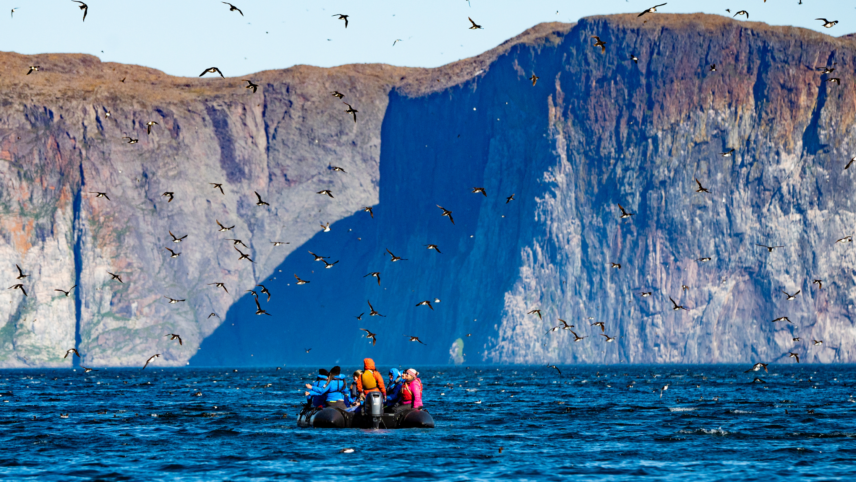
The Zodiac: that trusted inflatable rubber craft is the real vehicle of discovery. When conditions allow, you step off the ship, into a zodiac and cross a stretch of steel-grey Arctic water, and then touch down on a shoreline that a larger vessel could never reach. Beneath a bird cliff roaring with tens of thousands of kittiwakes. On a black sand beach where walrus have hauled out and simply do not care that you’re there.
I’ve done dozens of these landings across the Arctic and Antarctic. The Zodiac moment never gets old. The cold air on your face. The smell of the sea. The silence after the engine cuts. It is pure “awe”!

How the guides have evolved
This is the part that has changed most profoundly since my Marine Expeditions days, and it matters enormously for the quality of what you experience on board.
The specialists are still there. The glaciologist. The ornithologist. The marine biologist. Their expertise is non-negotiable. After all, you are travelling in regions that are scientifically extraordinary and ecologically urgent, and you deserve people who genuinely know them. But what has changed is the depth and breadth of that knowledge, and the understanding of why it matters.
The best guides working in polar regions today bring a cross-disciplinary fluency that goes far beyond their primary specialization. They can read sea ice conditions, identify seabirds , explain why the ice is blue, interpret climate signals in real time, and connect all of it to the human and cultural history of the place. They return to these regions season after season, year after year.
This depth has a reason behind it. These are remote, irreplaceable environments – and they deserve our full protection and understanding. That is not a phrase guides recite. It is a conviction that shapes how the best one’s work. The Polar Tourism Guides Association has done significant work in formalizing and raising those standards globally, developing qualifications and assessment frameworks that reflect just how much is required of someone who guides in polar environments. As their work makes clear, this is not guiding as entertainment. It is guiding as stewardship.
The result is an experience that doesn’t just inform you , it reorients you. You start to see yourself differently when you understand, viscerally, what it means to stand inside an ecosystem that is now changing faster than at any point in recorded history.
On expeditions like ours with Wild Women Expeditions, you’ll also encounter guest hosts – people like me, who bring a particular lived perspective to a place. A guest host isn’t a lecturer. We’re there to offer context rooted in personal experience: decades in extreme environments, a long relationship with the science, and the kind of stories that don’t make it into guidebooks. We give talks in the evenings perhaps, but we’re also beside you on the deck at midnight when the light does something extraordinary, and at dinner when you’re still processing what you saw that afternoon.
The places themselves
Svalbard sits at 78 degrees north – just 1,200 kilometres from the North Pole. Glaciers cover 60 percent of the land. Polar bears outnumber people. In summer, the sun doesn’t set for months, and the quality of the light at midnight does something to you that I have never been able to adequately describe. You simply have to experience it.
What strikes me every time – and I have been going to the Arctic for three decades – is how the landscape recalibrates your sense of scale.
“The silence is not empty. It’s full. Full of bird calls and wind and the low groan of ice under pressure. You are genuinely small in it, and that smallness is one of the most useful feelings a human being can have.”

The wildlife encounters are not guaranteed – and this is worth saying plainly. Ice and weather shape everything. But when a polar bear appears, moving across a snowfield at the edge of a fjord, something in you goes very quiet and very awake simultaneously. There is nothing like it.
The human side of small ship expedition travel
What distinguishes the best small ship expeditions from wildlife tours alone is the human dimension – the communities that live in and protect these extraordinary environments, and what happens when you’re invited into a genuine encounter with them.
Think of Sisimiut, Greenland’s second-largest town, sitting just north of the Arctic Circle on the western coast. Population around 5,500. One of the only ice-free harbours on Greenland’s western shore. A working fishing port where colourful wooden houses climb the rocky hillsides above the fjord, and sled dogs can still be heard from the waterfront. The Sisimiut Museum, housed in 18th-century colonial buildings near the harbour, holds artifacts from the Saqqaq culture dating back 4,500 years – one of the most complete records of Arctic human habitation anywhere.
When a small ship anchors in a place like Sisimiut, something different is possible. Local guides take you into the old town. You taste musk ox, dried cod, fresh shrimp -foods that connect directly to how people have survived here for millennia. You might visit an abandoned settlement by small boat, or hike the slopes of Naasaasaaq Mountain for a view that puts your own sense of geography in its proper perspective. You talk to people who actually live at the edge of the world, for whom the Arctic is not a destination but a home. That is not available from a ship of 3,000.
These encounters are only possible at a small ship scale. The intimacy is not a marketing point. It’s an ethical one – for the communities visited as much as for the traveller.
Come to Svalbard
I’ll be co-hosting Wild Women Expeditions’ Svalbard Explorer this summer – and I cannot tell you how much I’m looking forward to sharing this place with a group of women who are ready to be changed by it.
If Antarctica is on your horizon, Wild Women Expeditions’ new 2028 Spirit of Antarctica expedition is also open — the other end of the world, and its own kind of extraordinary.